Have you ever written a sentence and stopped at the words “alternately” or “alternatively”, unsure which one is correct? Many English learners, writers, and professionals search for this exact question because both words look similar, but their meanings are not the same.
This confusion is very common in emails, academic writing, job applications, and business communication. Using the wrong word can slightly change your meaning and make your writing unclear. That is why understanding alternately or alternatively is important for clear and correct English.
Both words come from the idea of “taking turns” or “choosing between options,” but they are used in different contexts. One is about switching in sequence, while the other is about offering a choice. Many people mix them because they sound close and are often used in similar sentences.
In this guide, you will learn the exact difference between alternately and alternatively, their origins, grammar rules, examples, common mistakes, and correct usage in real-life writing.
Alternately or Alternatively – Quick Answer
Alternatively
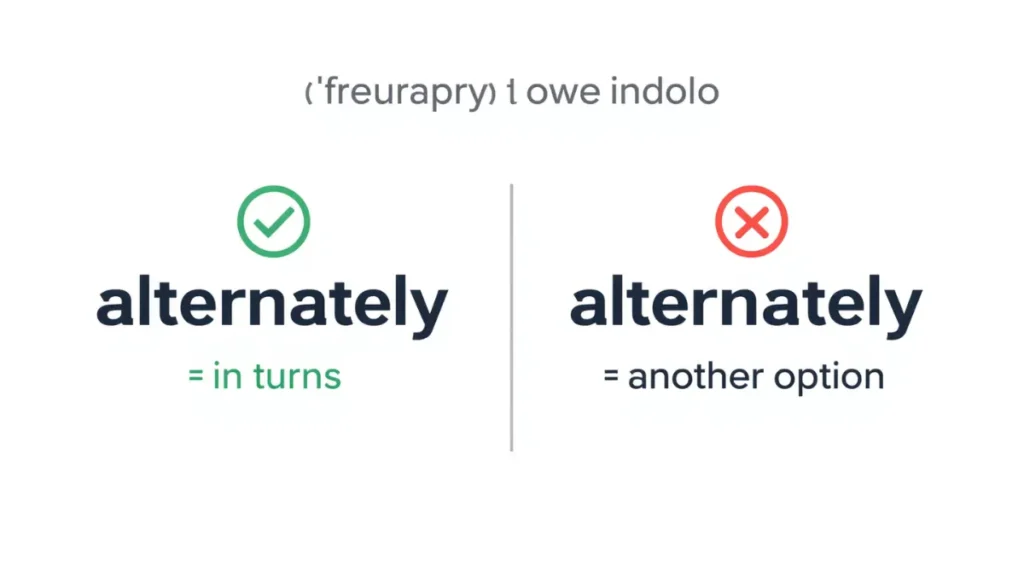
Alternatively means “as another option” or “on the other hand.”
✅ Example:
- You can travel by bus. Alternatively, you can take a train.
Alternately
Alternately means “in turns” or “one after another.”
Read more: Economic or Economical: What’s the Difference
✅ Example:
- The children spoke alternately during the presentation.
👉 Simple rule:
- Alternatively = choice
- Alternately = turn-taking
The Origin of Alternately or Alternatively
Both words come from the Latin root “alternus”, meaning “one after another” or “by turns.”
- Alternate → from Latin alternare (to do by turns)
- Alternative → developed later to mean “another option”
Over time, English created two adverbs:
- Alternately (sequence or turns)
- Alternatively (choice or option)
The meanings split as English evolved, which is why confusion happens today.
Read more: Historical or Historic: What’s the Difference
British English vs American English Spelling
Good news: There is no spelling difference between British and American English for these words.
Both regions use:
- Alternately
- Alternatively
The difference is only in usage frequency and clarity, not spelling.
Comparison Table
| Word | Meaning | US Usage | UK Usage |
| Alternately | In turns | Common | Common |
| Alternatively | Another option | Very common | Very common |
👉 Both English types follow the same grammar rules.
Which Spelling Should You Use?
Since spelling is the same, the real question is which word fits your meaning.
Use “Alternatively” when:
- You are giving options
- You are presenting choices
- You are suggesting another idea
Use “Alternately” when:
- Something happens in turns
- Actions repeat one after another
- You describe sequence behavior
Global Advice:
For most modern writing (blogs, business, academic), “alternatively” is used more often because offering choices is more common than describing turn-taking.
Common Mistakes with Alternately or Alternatively
❌ Mistake 1: Using alternately for choices
- ❌ You can call me, alternately email me.
- ✅ You can call me. Alternatively, email me.
❌ Mistake 2: Using alternatively for turns
- ❌ The players spoke alternatively.
- ✅ The players spoke alternately.
❌ Mistake 3: Mixing meanings in one sentence
- ❌ You can take tea, alternately coffee, alternately juice.
- ✅ You can take tea, coffee, or juice.
❌ Mistake 4: Overusing both words
- ❌ Alternately, you can go by bus. Alternatively, train is better.
- ✅ Alternatively, you can go by bus or take a train.
Alternately or Alternatively in Everyday Examples
Email Example
- “You can submit the form online. Alternatively, you may visit the office.”
Business Writing
- “The system can run in automatic mode or, alternatively, in manual mode.”
Social Media
- “Stay home and relax, or alternatively go for a walk.”
News Writing
- “The team can play defense first. Alternatively, they may focus on attack.”
Academic Writing
- “Students may choose Project A. Alternatively, they can select Project B.”
Alternately or Alternatively – Google Trends & Usage Data
Search behavior shows that:
- “Alternatively” is searched more often globally
- “Alternately” is less common but still important in grammar learning
- Confusion appears mostly in ESL (English as Second Language) countries
Usage Insight:
| Region | Most Used Word |
| United States | Alternatively |
| United Kingdom | Alternatively |
| India / Pakistan | Both (confused usage) |
| Global Writing | Alternatively |
👉 Conclusion: “Alternatively” dominates in professional writing.
Alternately vs Alternatively Comparison Table
| Feature | Alternately | Alternatively |
| Meaning | In turns | Another option |
| Usage Type | Sequence | Choice |
| Formal Writing | Moderate | Very common |
| Business English | Rare | Standard |
| Academic Writing | Limited | Preferred |
| Example | They spoke alternately | You can go, alternatively stay |
FAQs
1. What is the main difference between alternately and alternatively?
Alternately means in turns, while alternatively means another option.
2. Can I use alternatively instead of alternately?
No, because the meaning will change.
3. Which word is more common in English?
Alternatively is more common in modern writing.
4. Are both words correct?
Yes, both are correct but used in different contexts.
5. Is there a British vs American difference?
No, both dialects use the same spellings.
6. Why do people confuse these words?
Because they sound similar and share the same root origin.
7. What is a simple trick to remember?
Use:
- “Alternative = option”
- “Alternate = turn-taking”
Conclusion
Understanding alternately or alternatively is important for clear and professional English writing. Even though the words look similar, they carry completely different meanings. One describes actions happening in turns, while the other offers choices or alternatives.
Most confusion comes from their shared origin and similar spelling, but once you learn the simple rule—alternately for sequence and alternatively for choice—the difference becomes easy to remember.
In modern English, “alternatively” is more commonly used, especially in business, academic, and digital communication. However, “alternately” is still important when describing repeated or turn-based actions.
Using these words correctly improves your writing clarity and makes your communication more professional. Whether you are writing emails, essays, blogs, or social media posts, choosing the right word helps you express your ideas accurately and confidently.
With practice, this grammar point becomes simple and natural, helping you avoid one of the most common English mistakes.

I am Arshman Ali a professional English writer and English professor with a passion for language and a commitment to excellence. I bring precision and clarity to my writing, and the same high standards into my classroom. For me, language is not just a profession it is a purpose.