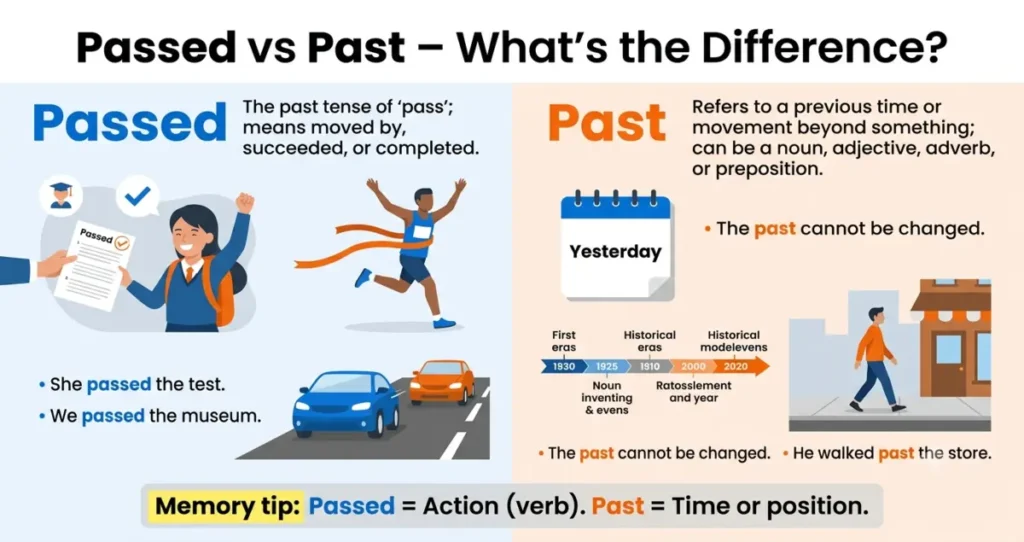
Many English learners and native speakers struggle with passed vs past. These two words sound similar, but they have different meanings and uses. Because they are often confused in writing, people frequently search for “passed vs past” to learn the correct choice.
The confusion happens because both words relate to time, movement, or events that have already happened. However, passed is usually a verb, while past is most often a noun, adjective, adverb, or preposition. Using the wrong one can make your writing look less professional and create misunderstandings.
For example, should you write, “The car passed me,” or “The car past me”? What about “It happened in the past” versus “It happened in the passed”? Only one option is correct in each sentence.
This guide explains the difference between passed vs past, their history, common mistakes, real-world examples, and tips for choosing the right word every time.
Passed vs Past – Quick Answer
Passed is the past tense and past participle of the verb pass.
Past refers to a time before now or something beyond a point.
Examples
✅ She passed the exam.
✅ The train passed the station.
✅ We talked about the past.
✅ Walk past the library and turn left.
Quick Rule
- Use passed when you mean went by, moved beyond, succeeded, or completed.
- Use past when referring to time, position, or direction.
Read more:Its or It’s: What’s the Difference and Which One Should You Use?
The Origin of Passed vs Past
The words passed and past come from the same historical root.
Origin of Pass
The verb pass entered English through Old French passer, meaning “to move through” or “to go by.” It ultimately comes from the Latin word passus, meaning “step.”
When the verb is used in the past tense, it becomes passed.
Examples:
- He passed the building.
- She passed the test.
Origin of Past
Past developed from older English forms meaning “gone by” or “beyond.” Over time, it became its own word used to describe previous time periods, locations, and directions.
Examples:
- The past cannot be changed.
- Walk past the store.
Although they share a common history, modern English treats them as different parts of speech.
Read more:Colon or Semicolon: What’s Difference and When You Use?
British English vs American English Spelling
Unlike many English spelling differences, passed and past are spelled the same in both British and American English.
The difference is based on grammar, not regional spelling.
Comparison Table
| Meaning | Correct Word | British English | American English |
| Moved beyond | Passed | Passed | Passed |
| Succeeded | Passed | Passed | Passed |
| Previous time | Past | Past | Past |
| Beyond a place | Past | Past | Past |
Examples
| Sentence | Correct Form |
| She ___ the exam. | Passed |
| Think about the ___. | Past |
| The car drove ___ us. | Past |
| The runner ___ everyone. | Passed |
There is no spelling variation between UK and US English.
Which Spelling Should You Use?
The correct choice depends on what you want to say.
Use Passed When:
- Talking about movement
- Talking about success in a test
- Referring to completion
- Describing something that happened
Examples:
- He passed the finish line.
- She passed her driving test.
- Time passed quickly.
Use Past When:
- Referring to previous time
- Describing direction
- Indicating location beyond something
Examples:
- The past teaches valuable lessons.
- Walk past the bank.
- In the past, people wrote letters.
Audience Advice
| Audience | Recommended Usage |
| US readers | Follow standard grammar rules |
| UK readers | Follow standard grammar rules |
| Commonwealth readers | Follow standard grammar rules |
| Global audience | Use passed for verbs and past for time/location |
Because the rule is universal, all English-speaking audiences expect the same usage.
Common Mistakes with Passed vs Past
Many writers accidentally swap these words.
Mistake #1
❌ I past the exam.
✅ I passed the exam.
Reason: Passing an exam is an action.
Mistake #2
❌ We learned from the passed.
✅ We learned from the past.
Reason: The word refers to earlier time.
Mistake #3
❌ The car passed the store and kept driving passed it.
✅ The car passed the store and kept driving past it.
Reason: First is a verb; second describes position.
Mistake #4
❌ Walk passed the building.
✅ Walk past the building.
Reason: This refers to direction.
Passed vs Past in Everyday Examples
Email Writing
✅ I passed the certification exam last week.
✅ Our discussion about the past was helpful.
News Headlines
✅ Student passes national examination.
✅ Museum explores the city’s past.
Social Media
✅ Can’t believe I finally passed my driving test!
✅ Looking back on the past year with gratitude.
Formal Writing
✅ The proposal passed committee review.
✅ Historical records reveal details about the region’s past.
Passed vs Past – Google Trends & Usage Data
Search interest for passed vs past remains high because it is one of the most common grammar mistakes in English.
Where Searches Are Popular
- United States
- United Kingdom
- Canada
- Australia
- India
Why People Search It
- School assignments
- Professional writing
- Exam preparation
- Business communication
- Grammar improvement
Context of Use
| Word | Most Common Context |
| Passed | Exams, movement, completion |
| Past | Time, history, direction |
| Passed vs Past | Grammar learning |
Grammar-related searches often spike during school terms and exam seasons.
Passed vs Past Comparison Table
| Feature | Passed | Past |
| Part of Speech | Verb | Noun, adjective, adverb, preposition |
| Meaning | Moved beyond, succeeded | Earlier time, beyond |
| Refers to Action | Yes | No |
| Refers to Time | No | Yes |
| Refers to Direction | No | Yes |
| Example | She passed the test. | The past matters. |
FAQs
1. Is it passed or past the store?
Use past.
✅ Walk past the store.
2. Is it passed the test or past the test?
Use passed.
✅ She passed the test.
3. What is the easiest way to remember passed vs past?
If it is an action or verb, use passed. If it refers to time or position, use past.
4. Can past be a noun?
Yes.
Example:
✅ The past influences the present.
5. Can passed be used as an adjective?
Usually no. It is mainly the past tense of the verb pass.
6. Why do people confuse passed and past?
They sound very similar and are connected historically, but they serve different grammatical roles.
7. Are passed and past interchangeable?
No.
Each word has a specific meaning and grammar function.
Conclusion
Understanding passed vs past is easier once you know the role each word plays in a sentence. Passed is the past tense of the verb pass, so it describes an action such as moving beyond something, completing a task, or succeeding in an exam. Past, on the other hand, usually refers to time that has already happened or a position beyond a certain point.
A simple memory trick is to ask whether the word describes an action. If it does, choose passed. If it describes time, history, location, or direction, choose past. This rule works in nearly every situation.
Another helpful tip is to check whether you can replace the word with “went by” or “succeeded.” If you can, passed is probably correct. If you are talking about earlier events or something beyond a location, past is the right choice.By learning this difference and practicing with real examples, you can avoid one of the most common English grammar mistakes and write with greater confidence and accuracy.

I am Arshman Ali a professional English writer and English professor with a passion for language and a commitment to excellence. I bring precision and clarity to my writing, and the same high standards into my classroom. For me, language is not just a profession it is a purpose.