Have you ever typed out a sentence, looked at it and thought, “Wait, is that the correct word?” You’re not alone. Thousands of people stop mid-sentence to ponder on the difference between elicit and illicit. Two words. One letter apart. Completely different meanings.
I mean, it’s not a simple spelling mistake. This can alter the meaning of your sentence when you mix up these words. The detective tried to elicit a confession and it looks like the detective did something shady.
The word that you likely intended was “elicit,” meaning “to evoke or draw out a response. It’s only when you make a single letter mistake that your sentence turns all around into something you never wanted to say.
This comparison is often sought by people when they use spellcheck on both the words are accepted. Neither is absolutely “incorrect” in itself. It’s all about choosing the right one in this sentence. Fast typing, autocorrect and the near identical pronunciation of these words when spoken rapidly make it easy to see how it can all be so confusing.
This guide explains it well. You’ll get a quick answer, the background, real-life scenarios
Let’s cut to the chase.
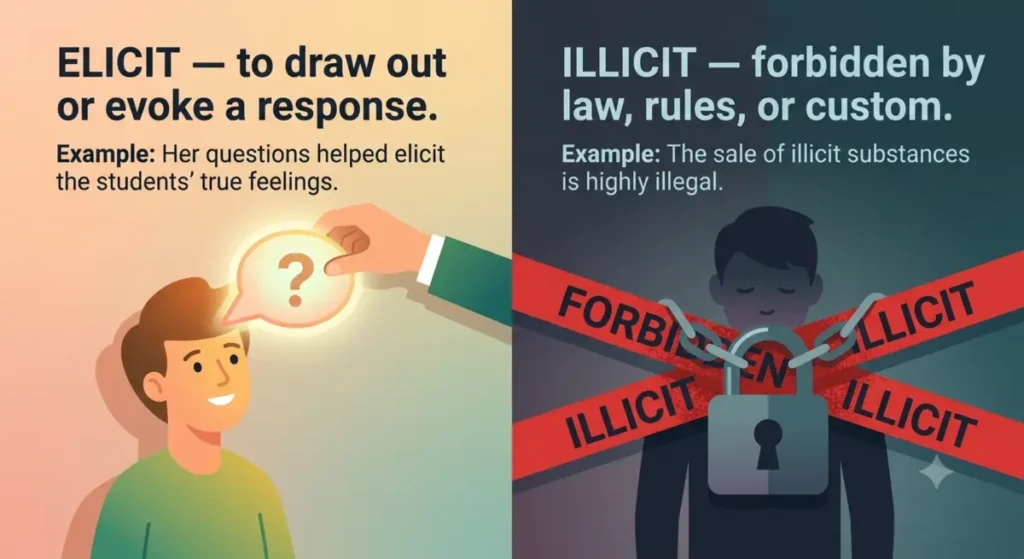
- Elicit – to evoke out of someone else.
- Example: Teacher asked a question, students discussed.
- Elicit (verb) is to call out or bring out a response, answer, or reaction.
- Example the police have closed an illegal gaming house.
The meaning of Illicit (adjective) is illegal or prohibited by social convention.
That’s really it. Traditional Elicit is getting something out of someone. The word illicit means something that is not allowed. They aren’t spelling variants of the same word. They’re two different words, but they sound alike.
A quick note: If you ask, “What starts with an “e?” you will get “extract. Remember: elicit = extract a response. The word Illicit contains two L’s, and you can imagine the double L as two prison bars: illegal, forbidden.
Read more:On Board or Onbord : Which Spelling Is Correct?
The origin of Elicit and Illicit is not known.
They both originate from the Latin language; that’s why they sound so alike, but have such very different meanings.
The word comes from the Latin root e- “out” and lacere “to entice or lure”. But at the heart of it, elicit actually means “to draw out”! It remains the same today; that’s how we all use it — to draw something out: a response, an answer, a feeling.
The meaning of Illicit is derived from the word illicitus used with the prefix in- meaning “not,” and licitus meaning “lawful”: as it comes from in- (meaning “not”) and licitus (meaning “lawful”): and “license” and “legitimate” share the same root. Illicit literally means “not lawful.
The confusion is not due to some spelling change in history or dialectal differences. The reason for this is that English borrowed two words from Latin, and they share the same sound pattern. Unlike the use of ‘colour’ and ‘color’, both of which developed similar spellings as time passed. There was always a difference between the words, as Elicit and Illicit sound alike in their pronunciation.
Read more:Is It Masters or Master’s? The Correct Grammar Explained Simply?
Do there exist any differences between British English and American English?
Many people fall into this trap; let’s cut to the chase, spelling is the same in both English and British English. Elicit and illicit are spelled the same way all over the English-speaking world, in the US, UK, Canada, Australia and elsewhere.
It is typically not a confusion on a regional basis. It’s phonetic. Since the words elicit and illicit are nearly identical in sound when spoken at normal speed, it is easy to accidentally confuse the words, so people in all English speaking countries sometimes do.
It is not about what the word means, it’s about how close the words sound when they are spoken.
I think it’s best to point out here that this is not a US vs UK split in spelling but a difference in meaning:
| Feature | Elicit | Illicit |
| Part of speech | Verb | Adjective |
| Meaning | To elicit or stimulate a response. | Illegal or forbidden |
| Root | To bring out of hiding (Latin elicere “to lure out”) | The word “illicitus” has the meaning of “not lawful. |
| Common use | Make a response, elicit information | A secret love affair, illicit drugs, illicit trade, |
| Regional spelling difference | None | None |
| Sounds like | “ih-LISS-it” | “ih-LISS-it” |
Pay attention to the pronunciation row. The reason for the mix-up is not geographical, not dialectical, but two similar-sounding words with very different functions.
Which Should You Use?
There’s no regional rule to adhere to so the question isn’t “which country am I writing for”. It’s “what am I trying to say?” It’s “what am I trying to say?”
Do I have to react to an individual or am I describing something illegal?
- When you are discussing extraction of information, feedback, emotions, or answers, you will want to elicit. This is a frequent occurrence in professional and academic writing: “The survey was constructed to solicit truthful comments.
- When you’re referring to something that is forbidden, illegal, or out of bounds, use the word illicit. This is seen in news, legal and true crime publications: “Authorities confiscated drugs at the border.
This is true even if you’re writing for Americans or Brits, or for everyone else in the world. It’s never “other” for the word “English”. Outside of formal, academic, legal, or business writing, there’s really nothing to say here except that when it does show up, which is when you’re writing formally, academically, legally, or for business, it’s what matters.
Making common mistakes with Elicit and Illicit.
Let’s examine the miscrews people actually commit.
Wrong answer #1: “The interrogation was intended to elicit a confession. Wrong. Correct: elicit, we want to get a confession.
Mistake 2: “She ran an illegal business which sold fake goods. Wrong. This needs to be “illegal” because the goods are counterfeit.
Mistake #3: Using “illicit” as a verb. It’s only an adjective if it is illegal. There is no such thing as an “illicit”! Elicit is the only verb that can be used for drawing something out.
Mistake 4: Mixing up “elicit” and “solicit. This is a bonus that is up for grabs. To solicit is to make a request or ask for something, especially in reference to asking for business or donations. The word elicit actually means to elicit, draw out a reaction, and is not exactly the same. She solicited donations (asked for donations) vs. Her speech elicited donations (caused donations).
Mistake 5: Autocorrect swaps. Autocorrect is likely to swap one for the other since they are similar in spelling. Be sure to check this pair before sending.
Understand the meanings of elicit and illicit in everyday language.
Words in context will increase retention.
In workplace writing: “This is a survey we are running to get input from the team that is honest. The audit revealed that there was improper spending in the department.
As news headlines read: “Officials Crack Down on Illicit Wildlife Trade” “New Ad Campaign Aims to Elicit Emotional Response from Viewers,” the images are striking.The pictures are powerful in news headlines that read: “Officials Crack Down on Illicit Wildlife Trade” and “New Ad Campaign Aims to Elicit Emotional Response from Viewers.
If you post anything on social media: “This post is meant to get a response — and it’s getting one. There are reports of “illegitimate activity” at the warehouse which are being investigated.”
Formal and academic writing: “Open ended questions were used to elicit deeper insight from the participants. The research looked at the cost of the illegal drug trade.
Take special note of the pattern: Notice that almost always goes with terms such as response, reaction, feedback, information, or emotion. When using the word illicit, it is almost always used with one of the words like trade, activity, substances, affair, or business.
Search Trends & Usage Data: Elicit vs Illicit
Both of these words have consistent search volumes, but for different reasons. The most common reason for conducting a search on “elicit vs illicit” is to verify their own spelling before sending an email, handing in an assignment, or posting content.
This type of search increases around the back to school time and in professional writing forums.
The word “Illicit” is often associated with news events, drug busts, corruption, and legal cases making headlines and resulting in spikes in search and usage of this word, as it’s a common term for crime and legal reporting.
As it is used frequently in relation to surveys, interviews, and behavioral research, it is also a word that is consistently sought after by students, marketers, and researchers of UX.
Let’s take a look at the examples of the two words in various contexts:
| Content Type | Elicit Usage | Illicit Usage |
| News & journalism | Occasional – emotional response stories | Often (crime, corruption, smuggling) |
| Academic writing | Frequent (research methodology) | Occasional (legal/criminology studies) |
| Marketing & UX | Hands-on (engage, elicit clicks) | Rare |
| Legal writing | Rare | Recurring (illegal behavior, illegal profits) |
Frequently Asked Questions
1. Is illicit (a word) a real word? Yes. In English, the word illegal is synonymous with the word “illegitimate”. It’s employed regularly in legal, news and general writing.
2. Is ‘elicit’ synonymous with ‘illicit’? No. They don’t have any meaning. Elicit: to evoke a response. If something is illegal or forbidden, then it is illicit. They are just similar in sound.
3.Why is it that people mix up the words elicit and illicit? They sound very much alike, and they only differ in two letters. They cannot be distinguished by ear and sometimes your fingers don’t get it right either.
4. Are there any British spellings of ‘elicit’ or ‘illicit’? No. In British English, American English and all other English dialects, these words are spelled the same. No regional differences in this.
5. What’s an easy trick to remember the difference? Find equivalents for “illicit” to “illegal” — they both involve the letter “il” and both mean something that is not allowed. Elicit is a synonym of extract, which also begins with an “e” and both refer to the act of drawing something out.
6. Is the word ‘illicit’ a verb? No, the word “Illicit” can only be used as an adjective. If you must have a verb, then you’re looking for elicit rather than illicit.
8. What is the formal/informal level of “elicit”? The term Elicit is perceived as a bit formal. It appears frequently in academic, business and research writing, but not in everyday speech.
Final Thoughts: Elicit vs Illicit Made Simple
In the end, there is no difference between the British version and the American version of “elicit” and “ilicit”. No dialect barrier to learn! You’re really just having to deal with two words that happen to start with the same letter and end with the same letter, but are pronounced quite differently.
To elicit, to call out something – a response, an answer, an feeling. If you say that something is illicit, you are saying that it is illegal or forbidden. To help you out here I want you to remember this difference between “extract” and “illegal” so you never have to think twice about it.
Make yourself a memory aid as before: illicit’s double L will remind you of prison bars — a visual reminder of “against the rules. This little mental hack will save you from a basic yet embarrassing mistake whether you are writing an email, a report, a news story or a social post.
To elicit, to call out something – a response, an answer, a feeling. If you say that something is illicit, you are saying that it is illegal or forbidden. To help you out here I want you to remember this difference between “extract” and “illegal” so you never have to think twice about it.
Make yourself a memory aid as before: illicit’s double L will remind you of prison bars — a visual reminder of “against the rules. This little mental hack will save you from a basic yet embarrassing mistake whether you are writing an email, a report, a news story or a social post.
This is a common problem in which many accomplished writers experience language mix-ups. The good news? Once you realize the true difference, you’ll see it immediately each time!Elicit vs illicit – confused? Understand the true meanings, etymology, pitfalls and quick tips for each word.

I am Bahadar Ali, a professional content writer and the author behind GrammarDrive.com. I am passionate about making grammar simple and accessible for everyone. Through my writing, I aim to help learners and professionals communicate with clarity and confidence.