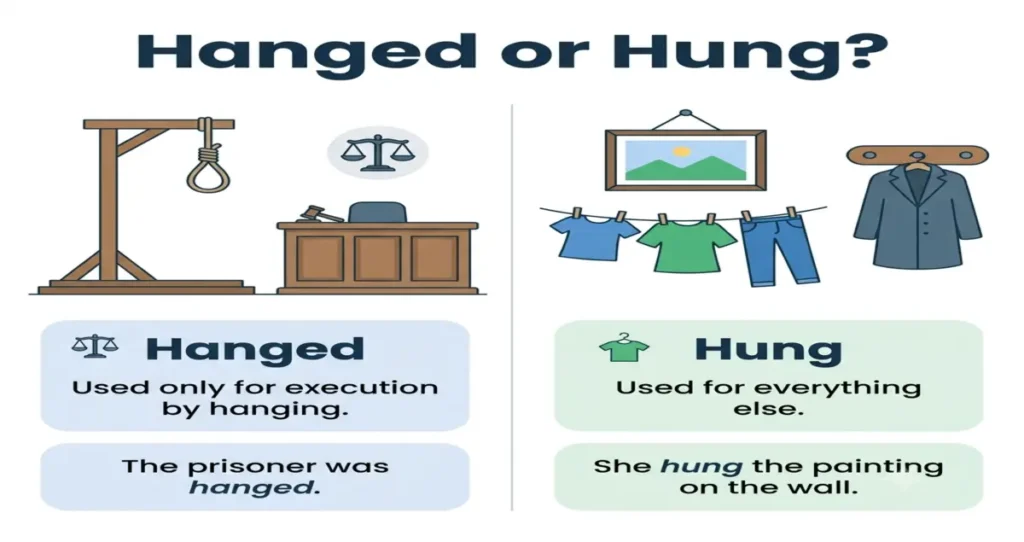
At any point have you paused to ask yourself when writing this question: Should I write “hanged” or “hung“? You’re not alone. It is easy to confuse these two words, since they are both derived from the verb hang, and this is the reason that many English learners, students and even native speakers get them confused.
The confusion is because of the fact that both the words are correct but used in different situations. Hung would be the most common alternative, but in most cases, you will use hung. But hanged has one very particular meaning that sets it apart. The wrong one can make your sentence sound strange or even entirely change its meaning.
The good news is, when you know the rule it’s very easy to remember! You will find out which words are hanged and which are hung, where they originate, how they are used in Britain and in the USA, some of the most common errors you should avoid and lots of examples. At the end, you’ll have a firm grasp on which word to use without hesitation!
Hanged or Hung – Answer right away
The difference lies in the following:
- For nearly everything, hang is both past and past participle, and is also the past tense and past participle of hang itself.
- Only used in the context of hanged, hanging someone.
Examples
✅ She displayed the picture on the wall.
✅ We hung our coats by the door.
Decorations were set up prior to the party.
✅ The criminal was hanged for his crime.
In times gone by, there have been hangings at these locations.
Read more:Unique or Very Unique which one is correct?
Quick Rule
| Word | Meaning | Example |
| Hung | Takes advantage of objects and common choices of action.Applies objects and common actions. | She hung the painting on the wall. |
| Hanged | Appropriated for hanging (execution) | The prisoner was executed by hanging. |
Easy memory trick:
Objects are hung. The law provides for the hanging the dead.
Hanged or Hung is part of the Hanged series.
The hanged and hung are both from the Old English verb hangian and hon, meaning “to suspend”.
The word hang used to have several past tenses forms hundreds of years ago in English. With time, the natural extension to the language of the people started to use hung in normal situations.
Still the legal system continued to use “hanged” in the sense of “hanging” when talking of death by hanging. This special form is still in use because the language of the law evolves slowly.
Read more:Whether a colon should follow i.e or e.g. and when is up to debate.
Today:
- The normal past tense form of Hung is hung.
- There is a legal and historical exception, however, for the hanged: hanged remains a legal and historical exception.
This is one of the few verbs in English that has a special past tense for one (and only one) of its meanings.
American English vs British English
The difference in spelling between British English and American English for hanged and hung is the same as many other differences in the English language.
The two varieties have the same spelling.
Comparison Table
| Situation | British English | American English |
| Picture on a wall | Hung | Hung |
| Clothes on a hook | Hung | Hung |
| Christmas lights | Hung | Hung |
| Person executed | Hanged | Hanged |
| Curtains | Hung | Hung |
Both styles are totally alike.
Which Spelling to Use?
This is not influenced by your audience.
If you are creating for the United States
Use:
- Suspended on regular occasions
- Suspended for execution by the law
For the United Kingdom:
The same applies.
If you’re writing for an international audience
Continue using the same rule.
No regional preference is shown.
Best Advice
What is that one question?
Are they being put to death?
- Yes → Hanged
- No → Hung
There’s only one thing you have to keep in mind.
Common mistakes with Hanged or Hung
It is common for writers to use the word hanged instead of the word hang and not realize that this is an error.
Here are some of the typical errors.
| Incorrect | Correct |
| She hung the painting up. | She hung the painting on the wall. |
| We hung our coats up. | We hung our coats. |
| A picture was hanged today. | The picture was put up last night. |
| The prisoner was executed by hanging. | The condemned man was executed by hanging. |
| They hanged the culprit. | They hung the murderer. |
Remember
✅ Hung → Objects
✅ Hanged → Execution
Hanged/Hung in Everyday Examples
In Emails
Now I have put the new white board in the meeting room.
We set up the company banner prior to the event.
In News
The painting was exhibited in the museum yesterday.
The final court ruling was that the prisoner be hanged after the ruling.
On Social Media
Lastly, I hung my new TV!
We lit Christmas lights around the garden today.
In Formal Writing
The portrait was hung above the fireplace.
The tradition of hanging has been followed since ancient times for the execution of convicted traitors.
Hanged or Hung Google Trends & Usage Data.Google Trends & Usage Data
That’s why hung is so much more frequent than hanged, according to a search of the data.
Usage by Context
| Word | Common Context |
| Hung | The decoration of a house, clothes, art work, signs, lights. |
| Hanged | History, law, crime, legal punishment; |
Popular Countries
The hanged or hanged man is a common position searched in:
- United States
- United Kingdom
- Canada
- Australia
- India
The question is on the popular list because the English learner may see the two words in print and not understand why they are both past tense.
Hanged vs Hung Comparison Table
| Feature | Hung | Hanged |
| Part of speech | Past tense & past participle | Special past tense & past participle – Exercises. |
| Everyday use | Yes | No |
| Used for objects | Yes | No |
| Employed in lawful executions | No | Yes |
| British English | Yes | Yes |
| American English | Yes | Yes |
| Common in conversation | Very common | Rare |
| Easy example | She hung the mirror up. | The prisoner was executed by hanging. |
FAQs
An “a” or “as”, or a “hang” or “hung”?
Use hung.
Correct:
She hung up the painting.
Why is it that we say hanged rather than hung?
Legal execution by hanging is the only use of the word hanged.
May I say, somebody was hung?
The standard word for “execution” is hanged.
Does the word “Is” always refer to “Are”?
No.
In normal situations it is right but, for executions, it is wrong.
Is hanged old-fashioned?
No.
Still the proper word when writing legal or historical documents.
Are there any different rules for British English and American English?
No.
They both employ the same distinction.
What can I do to remember the difference?
Remember this basic principle:
Pictures are hung. Prisoners are hanged.
Conclusion
The hanged or hung is not as difficult as it sounds. Both words derive from the same verb but the modern English forms have different roles. In almost every day to day scenario this is the right word to use. Hang a picture, hang curtains, hang clothes or hang decorations. These examples are the ones you will encounter most in books, newspapers, e-mail, and in conversations.
The exception with hanged is a special exception. When referring to a person who was hung to death, it is used only then. This meaning is only used in legal and historical contexts, which is why it is not used by most people. Hence, hung is used much more frequently in the common language.
When in doubt, ask the following question: Do you mean object or execution? If it’s an object, choose hung. If it’s a legal execution, select hanged. Applying this rule will enable you to write naturally, accurately and confidently in both British and American English.

I am Bahadar Ali, a professional content writer and the author behind GrammarDrive.com. I am passionate about making grammar simple and accessible for everyone. Through my writing, I aim to help learners and professionals communicate with clarity and confidence.