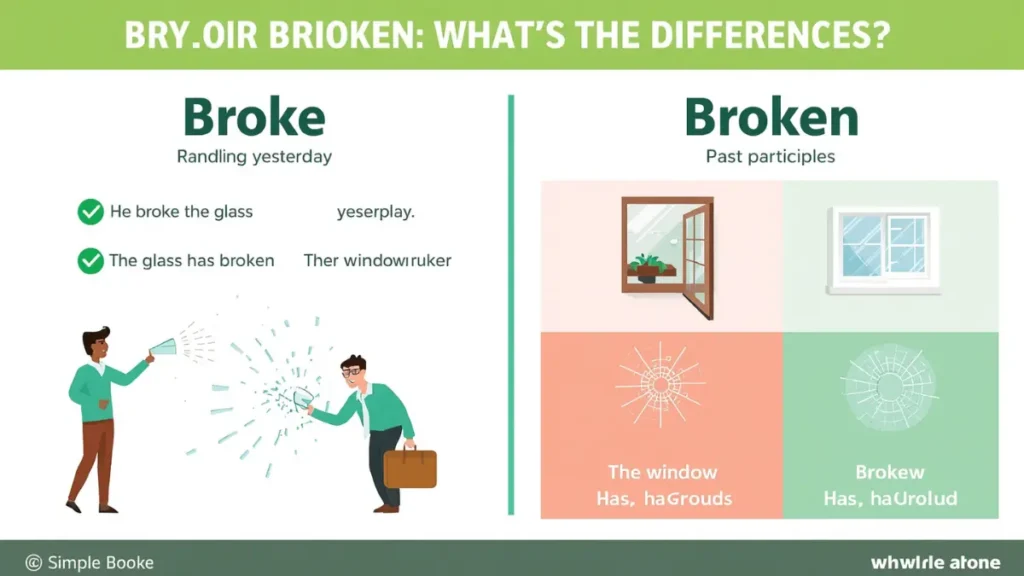
Many people search for “broke or broken” because these two words look similar but mean different things. They both come from the verb “break,” yet they are used in different ways in English grammar. This can confuse students, writers, and even native speakers.
For example, should you say “My phone is broke” or “My phone is broken”? Is “broke” only about money? Why do people use both online? These questions are very common.
Understanding the difference between “broke” and “broken” helps you write better emails, social posts, school work, and business messages. It also helps you sound more natural in English conversations.
In this guide, you will learn the quick answer, the history behind the words, spelling and grammar differences, common mistakes, and real-life examples. You will also see usage trends and simple tips for choosing the correct word every time.
Broke or Broken – Quick Answer
“Broke” and “broken” are both forms of the verb “break,” but they are used differently.
- Broke = simple past tense of “break”
- Broken = past participle or adjective
Examples
| Word | Correct Example | Meaning |
| Broke | I broke my laptop yesterday. | Action happened in the past |
| Broken | My laptop is broken. | Something is damaged |
Easy Rule
- Use broke for a past action.
- Use broken to describe a condition or state.
The Origin of Broke or Broken
The words “broke” and “broken” come from the Old English word brecan, which means “to split” or “to destroy.”
Over time, English grammar changed. Different forms of the same verb developed:
| Verb Form | Example |
| Base Verb | break |
| Past Tense | broke |
| Past Participle | broken |
The spelling difference exists because English keeps older verb patterns. Many irregular verbs work this way.
Similar Examples
| Base Verb | Past Tense | Past Participle |
| speak | spoke | spoken |
| wake | woke | woken |
| break | broke | broken |
This is why “broke” and “broken” both exist today.
British English vs American English Spelling
There is no major spelling difference between British English and American English for “broke” and “broken.” Both forms are used the same way in both regions.
However, usage style can differ slightly in informal speech.
Comparison Table
| Usage | American English | British English |
| I broke the glass. | Common | Common |
| The glass is broken. | Common | Common |
| I’m broke. | Very common slang | Common slang |
| He has broken the rule. | Less formal speech | More common in formal speech |
Important Note
In American English, people often use simple past tense more in casual conversation.
Example:
- US: “I already broke it.”
- UK: “I’ve broken it already.”
Both are correct.
Which Spelling Should You Use?
The correct choice depends on grammar, not region.
Use “Broke” When:
- Talking about a past action
- Describing losing money informally
Examples
- She broke the window.
- I’m broke after shopping.
Use “Broken” When:
- Describing something damaged
- Using perfect verb tenses
Examples
- The chair is broken.
- He has broken the law.
Audience-Based Advice
| Audience | Best Choice |
| US readers | Use natural conversational style |
| UK readers | Formal grammar matters more |
| Global audience | Use standard grammar clearly |
For professional writing, “broken” is usually safer when describing damage.
Common Mistakes with Broke or Broken
People often mix these words because they sound connected.
Mistake 1: Using “broke” as an adjective
❌ My computer is broke.
✅ My computer is broken.
Mistake 2: Using “broken” as simple past tense
❌ I broken the cup yesterday.
✅ I broke the cup yesterday.
Mistake 3: Confusing money slang
❌ I am broken this month.
✅ I am broke this month.
Quick Correction Guide
| Wrong | Correct |
| The car is broke. | The car is broken. |
| She broken my phone. | She broke my phone. |
| I’m broken after buying food. | I’m broke after buying food. |
Broke or Broken in Everyday Examples
These words appear everywhere in daily life.
In Emails
- “The printer is broken.”
- “I broke the attachment link by mistake.”
In News Headlines
- “Storm Broke Power Lines Across City”
- “Broken Roads Cause Traffic Problems”
On Social Media
- “I’m broke until payday.”
- “My screen is totally broken.”
In Formal Writing
- “The agreement was broken.”
- “The employee broke company policy.”
Broke or Broken – Google Trends & Usage Data
Search interest for “broke or broken” is high because learners often want quick grammar help.
Popular Usage by Context
| Word | Common Meaning |
| Broke | Past action or no money |
| Broken | Damaged condition |
Popular Countries Searching the Topic
- United States
- United Kingdom
- India
- Canada
- Australia
Why People Search It
Most users want to know:
- Which word is grammatically correct
- Whether “broke” means damaged
- How native speakers use both words
“Broken” appears more in formal writing, while “broke” is very common in speech and slang.
Comparison Table: Broke vs Broken
| Feature | Broke | Broken |
| Grammar Type | Past tense | Past participle/adjective |
| Main Use | Past action | Damaged state |
| Example | I broke the vase. | The vase is broken. |
| Formal Writing | Yes | Yes |
| Slang Meaning | No money | Emotional damage sometimes |
| Common in Speech | Very common | Very common |
FAQs About Broke or Broken
1. Is it correct to say “I am broke”?
Yes. “Broke” means having no money in informal English.
2. Is “my phone is broke” correct?
No. The correct phrase is “my phone is broken.”
3. What is the difference between broke and broken?
“Broke” is a past action. “Broken” describes a damaged condition.
4. Can “broken” describe emotions?
Yes. Example: “He felt broken after the loss.”
5. Is “broke” formal English?
It is acceptable, but it sounds informal when talking about money.
6. Which word is more common online?
Both are common, but “broken” appears more in formal content.
7. Do British and American English use different spellings?
No. Both use the same spellings.
Conclusion
Understanding the difference between “broke” and “broken” is simple once you know their grammar roles. “Broke” is the past tense of “break,” while “broken” is the past participle and adjective form. This means “I broke the glass” talks about an action, but “the glass is broken” describes the result.
Many English learners confuse these words because both come from the same verb. The confusion also grows because “broke” has a second meaning related to money. Still, the grammar rule is easy to remember: use “broke” for actions in the past and “broken” for damaged conditions or perfect tenses.
Both British and American English use these words in the same way, although style and sentence structure may differ slightly. In formal writing, choosing the correct form improves clarity and professionalism.
When in doubt, ask yourself one question: are you describing an action or a condition? The answer will help you choose the correct word every time..

I am Bahadar Ali, a professional content writer and the author behind GrammarDrive.com. I am passionate about making grammar simple and accessible for everyone. Through my writing, I aim to help learners and professionals communicate with clarity and confidence.