Many people search for “drunk or drank” because these two words sound similar but are used in different ways. It is a common English grammar problem for students, writers, and even native speakers. You may have heard someone say, “I drunk too much coffee,” while another person says, “I drank too much coffee.” So which one is correct?
The confusion happens because both words come from the same verb: drink. But they belong to different grammar tenses. One is used for the past action, and the other is used with helping verbs. Understanding this difference can improve your speaking and writing.
This guide explains the meaning of drunk or drank in simple words. You will learn the grammar rules, spelling differences, common mistakes, and real-life examples. We will also compare British English and American English usage so you can choose the right word with confidence.
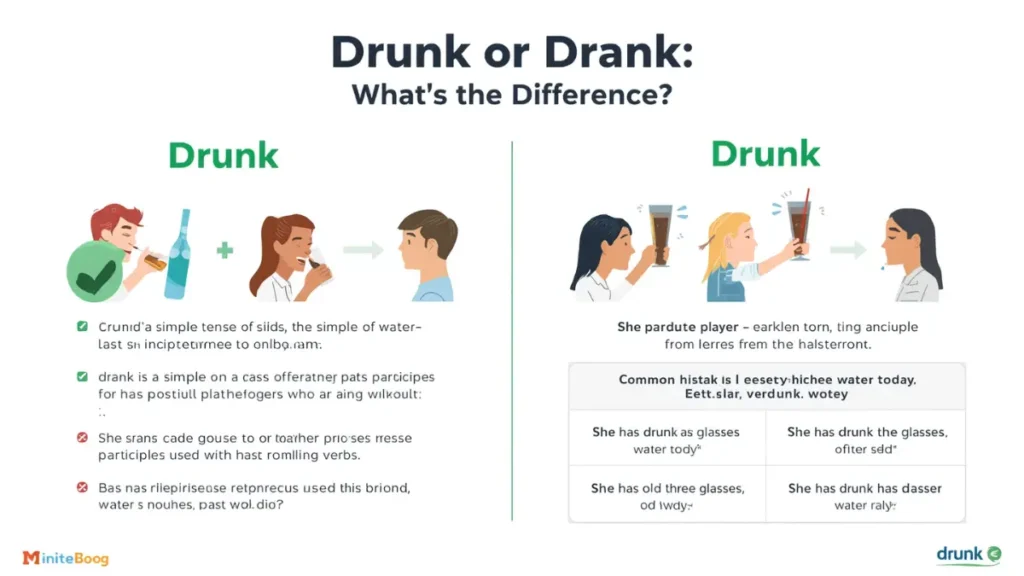
Drunk or Drank – Quick Answer
The quick answer is simple:
- Drank = simple past tense of drink
- Drunk = past participle of drink
Examples
✅ I drank water yesterday.
✅ She has drunk all the juice.
❌ I drunk water yesterday.
❌ She has drank all the juice.
Use drank when talking about a finished action in the past.
Use drunk after helping verbs like:
- has
- have
- had
Read more; Borrow or Lend: Understanding the Difference
The Origin of Drunk or Drank
The words drank and drunk come from the Old English verb drincan, which meant “to swallow liquid.”
Over time, English changed, and the verb developed different forms:
| Verb Form | Word |
| Base Verb | Drink |
| Past Tense | Drank |
| Past Participle | Drunk |
This pattern is common in irregular English verbs.
Examples:
- sing → sang → sung
- ring → rang → rung
- drink → drank → drunk
Read more: Teach or Learn: Understanding the Difference
The spelling differences exist because English kept older Germanic grammar patterns instead of adding “-ed” like regular verbs.
British English vs American English Spelling
There is no major spelling difference between British English and American English for drank and drunk. Both forms are spelled the same in both regions.
The main difference is in casual speech and grammar habits.
American English
American English strongly follows standard grammar rules.
Examples:
- I drank coffee this morning.
- He has drunk too much soda.
British English
British English uses the same grammar, but in casual conversation, some dialects may sound different.
Examples:
- She drank tea yesterday.
- They have drunk all the milk.
Comparison Table
| Usage | American English | British English |
| Past tense | drank | drank |
| Past participle | drunk | drunk |
| Formal writing | strict grammar | strict grammar |
| Casual speech | sometimes simplified | regional variations |
Which Spelling Should You Use?
The correct choice depends on grammar, not location.
Use “Drank” When:
- talking about a past action
- no helping verb is used
Example:
- I drank orange juice.
Use “Drunk” When:
- using has, have, or had
Example:
- I have drunk enough water.
Audience-Based Advice
| Audience | Best Choice |
| US readers | Follow standard grammar carefully |
| UK readers | Same grammar rules apply |
| Global audience | Use standard English forms |
For blogs, business writing, school work, and news articles, always use the correct tense.
Common Mistakes with Drunk or Drank
Many people mix these words because both refer to drinking in the past.
Mistake 1
❌ I drunk coffee yesterday.
✅ I drank coffee yesterday.
Mistake 2
❌ She has drank all the tea.
✅ She has drunk all the tea.
Mistake 3
❌ We had drank before dinner.
✅ We had drunk before dinner.
Easy Trick to Remember
- Drank works alone.
- Drunk works with helping verbs.
Drunk or Drank in Everyday Examples
Here are real-world examples of correct usage.
In Emails
- I drank the bottled water from the fridge.
- The team has drunk all the coffee already.
In News Writing
- The athlete drank water during the race.
- Officials said the driver had drunk alcohol before the accident.
On Social Media
- I drank three smoothies today!
- He has drunk six cups of coffee already.
In Formal Writing
- Participants drank filtered water during the study.
- The patient had drunk very little liquid before treatment.
Drunk or Drank – Google Trends & Usage Data
Search data shows that many people search for:
- “drunk or drank”
- “is it drank or drunk”
- “have drank or have drunk”
This happens because English learners often confuse past tense and past participle verbs.
Popularity by Region
| Country | Common Search |
| United States | drank vs drunk |
| United Kingdom | have drunk or drank |
| Canada | drunk or drank grammar |
| Australia | drank or drunk correct usage |
Usage Context
| Context | Common Form |
| Daily speech | drank |
| Grammar lessons | drunk vs drank |
| Formal writing | correct tense forms |
| Social media | both forms often mixed |
Drunk vs Drank Comparison Table
| Feature | Drank | Drunk |
| Grammar type | Past tense | Past participle |
| Used alone | Yes | No |
| Needs helping verb | No | Yes |
| Example | I drank tea | I have drunk tea |
| Formal English | Correct | Correct |
FAQs About Drunk or Drank
Is “I drunk water” correct?
No. The correct sentence is:
- I drank water.
Is “have drank” correct?
No. The correct form is:
- have drunk
Why do people confuse drunk and drank?
Because both words come from the verb “drink” and refer to past actions.
Which is more formal: drunk or drank?
Both are formal when used correctly.
Is “drunk” only used for alcohol?
No. “Drunk” is also the past participle of drink.
Example:
- She has drunk enough milk today.
Do British people say “drank” or “drunk”?
They use both correctly based on grammar rules.
What is the easiest way to remember?
Use:
- drank = simple past
- drunk = after has/have/had
Conclusion
Understanding the difference between drunk or drank is easier once you know the grammar rule. Drank is the simple past tense, while drunk is the past participle used with helping verbs like has, have, and had. Even though the words sound similar, they cannot always replace each other.
This grammar mistake is very common in daily conversation, social media posts, and informal writing. However, using the correct form makes your English sound more natural and professional. Whether you write for school, work, blogs, or business, choosing the right word improves clarity.
Remember this simple rule:
- Use drank alone.
- Use drunk with a helping verb.
Both British English and American English follow the same grammar pattern, so the rule works everywhere. By practicing real-life examples and avoiding common mistakes, you can confidently use both words correctly in any situation.

I am Arshman Ali a professional English writer and English professor with a passion for language and a commitment to excellence. I bring precision and clarity to my writing, and the same high standards into my classroom. For me, language is not just a profession it is a purpose.