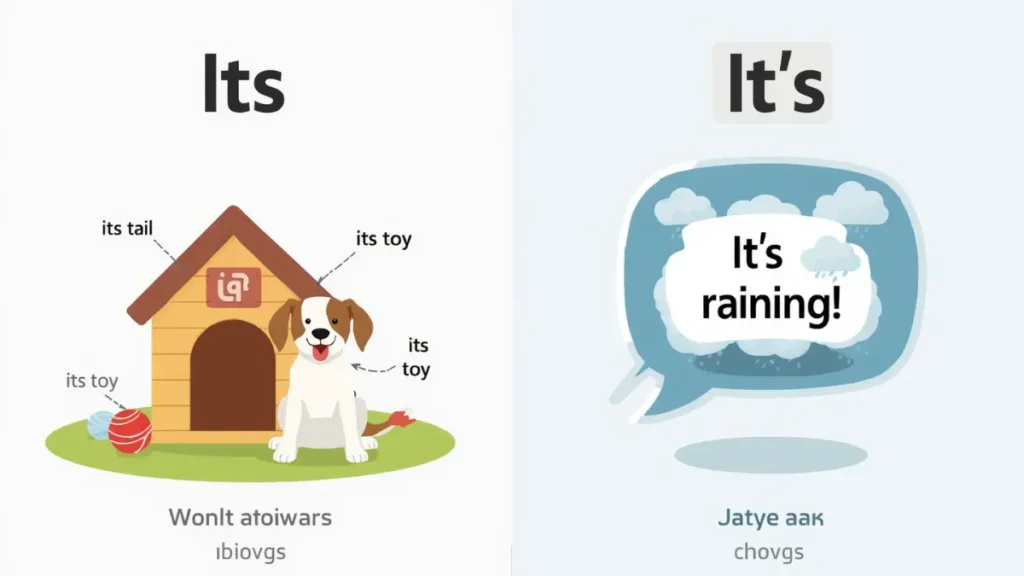
Many people struggle with its or it’s because the two words look almost identical. The only visible difference is the apostrophe, but that tiny mark completely changes the meaning. This grammar mistake appears often in emails, school assignments, social media posts, and even professional writing.
For example:
- “The dog wagged it’s tail” is incorrect.
- “The dog wagged its tail” is correct.
People search for its or it’s because they want a quick grammar answer and simple rules they can remember easily. The confusion happens because apostrophes usually show possession in English, but “it’s” is actually a contraction meaning “it is” or “it has.” Meanwhile, “its” shows ownership without an apostrophe.
This guide explains the difference between its and it’s using easy examples, grammar tips, comparison tables, and common mistakes. By the end, you will know exactly when to use each form in formal and everyday English writing.
Its or It’s – Quick Answer
Quick Rule
- Its = shows ownership
- It’s = short form of “it is” or “it has”
Read more: Learnt or Learned: Which Spelling Is Correct ?
Examples
| Word | Example |
| Its | The cat cleaned its paws. |
| It’s | It’s raining outside. |
Easy Memory Trick
Replace it’s with:
- it is
- it has
If the sentence still makes sense, use it’s.
Example:
- It’s cold today → It is cold today ✔
Read more: Dreamt or Dreamed: Which One Is Correct in English?
The Origin of Its or It’s
The word its developed as a possessive form of “it.” Unlike many possessive nouns, it does not use an apostrophe.
The word it’s is a contraction created by combining:
- it
- is
or
- it
- has
Word Origins
| Word | Origin | Meaning |
| Its | Possessive pronoun | Ownership |
| It’s | Contraction | It is / It has |
English grammar kept these forms separate to avoid confusion between possession and contractions.
British English vs American English Spelling
There is no spelling difference between British and American English for its or it’s.
Both forms follow the same grammar rules in:
- the United States
- the United Kingdom
- Canada
- Australia
Comparison Table
| Meaning | Correct Word |
| Ownership | Its |
| It is / It has | It’s |
Examples
| Sentence | Correct Form |
| The company changed ___ logo. | its |
| ___ been a long day. | It’s |
Which Spelling Should You Use?
The correct choice depends on sentence meaning, not location.
Use “Its” When:
- Showing ownership
- Talking about something belonging to an object or animal
Examples
- The bird lost its feathers.
- The school changed its rules.
Use “It’s” When:
- You mean “it is”
- You mean “it has”
Examples
- It’s a beautiful morning.
- It’s been a busy week.
Best Advice
Try replacing the word with:
- it is
- it has
If the sentence works, use it’s.
Common Mistakes with Its or It’s
This is one of the most common grammar mistakes in English.
| Incorrect | Correct |
| The dog hurt it’s leg. | The dog hurt its leg. |
| Its raining today. | It’s raining today. |
| The company changed it’s name. | The company changed its name. |
Mistake 1: Using apostrophes for possession
Most possessive nouns use apostrophes, but “its” does not.
Mistake 2: Forgetting contractions
“It’s” only means:
- it is
- it has
Mistake 3: Typing too quickly
Many people make this mistake on phones and social media.
Its or It’s in Everyday Examples
In Emails
- “The business updated its website.”
- “It’s important to reply quickly.”
In News Writing
- “The company announced its profits.”
- “It’s expected to grow next year.”
On Social Media
- “It’s finally Friday!”
- “The cat loves its new bed.”
In Formal Writing
- “The organization revised its policy.”
- “It’s necessary to follow safety rules.”
Its or It’s – Google Trends & Usage Data
Search trends show that its or it’s is one of the most searched English grammar questions online.
Why People Search It
| Reason | Explanation |
| Apostrophe confusion | Possession vs contraction |
| Similar appearance | Only one mark changes meaning |
| Common writing mistake | Frequent online error |
Popular Search Queries
- its vs it’s
- when to use its
- when to use it’s
- its meaning grammar
Country Trends
| Country | Common Usage Issue |
| United States | Apostrophe mistakes |
| United Kingdom | Grammar confusion |
| Canada | Formal writing corrections |
| Australia | Student writing questions |
Its vs It’s Comparison Table
| Feature | Its | It’s |
| Meaning | Ownership | It is / It has |
| Apostrophe | No | Yes |
| Grammar Type | Possessive pronoun | Contraction |
| Shows possession | Yes | No |
| Example | Its color is blue. | It’s raining. |
FAQs About Its or It’s
1. What is the difference between its and it’s?
“Its” shows ownership. “It’s” means “it is” or “it has.”
2. Is “its” possessive?
Yes. “Its” is a possessive pronoun.
3. Does “it’s” always mean “it is”?
“It’s” can mean:
- it is
- it has
4. Why does “its” not have an apostrophe?
Because possessive pronouns in English usually do not use apostrophes.
5. How can I remember the difference?
Replace “it’s” with “it is.” If it works, use “it’s.”
6. Is “its” used in formal writing?
Yes. It is common in all forms of writing.
7. Why do people confuse its and it’s?
Because apostrophes usually show possession in English.
Conclusion
Understanding its or it’s is important because this grammar mistake appears everywhere in English writing. Although the words look nearly identical, their meanings are completely different. “Its” shows ownership, while “it’s” is a contraction meaning “it is” or “it has.”
Many writers become confused because apostrophes often show possession. However, possessive pronouns like “its” do not use apostrophes. That is why remembering the contraction rule is the easiest way to avoid mistakes.
Whenever you see “it’s,” replace it with “it is” or “it has.” If the sentence still makes sense, then “it’s” is correct. If not, use “its.”
Learning grammar differences like its or it’s helps improve writing clarity, professionalism, and confidence. With regular practice, choosing the correct form will become natural in both formal and casual writing.

I am Arshman Ali a professional English writer and English professor with a passion for language and a commitment to excellence. I bring precision and clarity to my writing, and the same high standards into my classroom. For me, language is not just a profession it is a purpose.