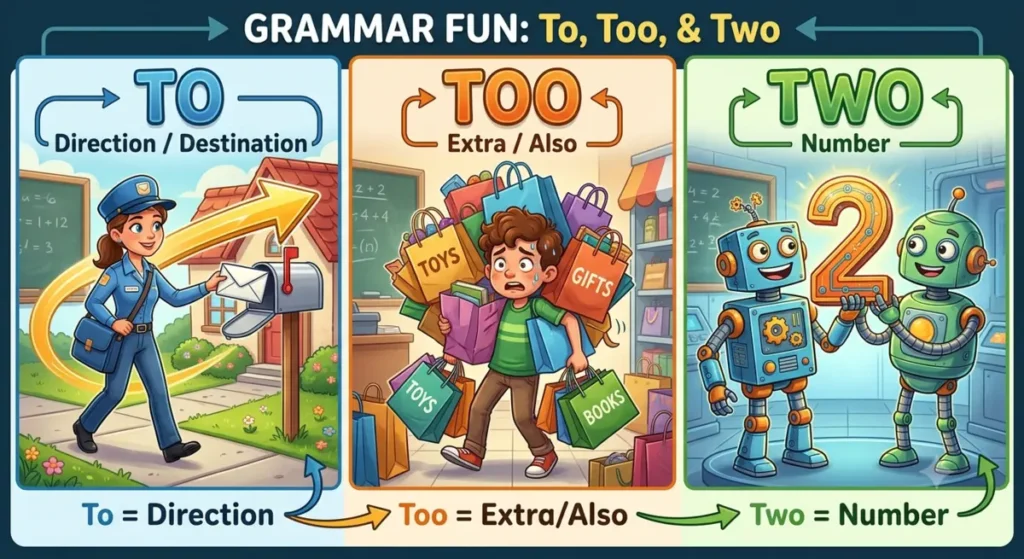
Many English learners struggle with the to too two difference because these words sound the same but have different meanings. They are called homophones. People often search for this topic because using the wrong word can make writing look careless or confusing.
For example, should you write “I want to go,” “I want too go,” or “I want two go”? Only one is correct. Small mistakes like this appear in emails, school work, blogs, and social media every day.
The good news is that learning the difference between to, too, and two is simple. Each word has one main job. Once you know the rules, you can avoid common grammar mistakes and write with confidence.
In this guide, you will learn quick definitions, word origins, spelling rules, common mistakes, real-life examples, and helpful tips for choosing the correct word every time.
To Too Two Difference – Quick Answer
Here is the simple difference:
- To → shows direction, purpose, or action.
- Too → means “also” or “very.”
- Two → means the number 2.
Read more: Stole or Stolen: Which Word Should You Use?
Examples
| Word | Meaning | Example |
| To | Direction or action | I am going to school. |
| Too | Also or very | I want ice cream too. |
| Too | Extra amount | The bag is too heavy. |
| Two | Number 2 | I have two cats. |
Quick Memory Trick
- Too has an extra “o” because it means “extra.”
- Two starts with “tw” like “twice.”
- To is the shortest and most common.
Read more: Broke or Broken: Difference and Which One Should You Use?
The Origin of To Too Two Difference
The words to, too, and two come from Old English. Over time, their spelling stayed different, but their pronunciation became almost the same.
Origin of “To”
“To” comes from the Old English word tō. It was used to show movement, direction, or purpose.
Example:
- She walked to the park.
Origin of “Too”
“Too” developed from an older English word meaning “in addition” or “more than enough.”
Examples:
- I want to come too.
- The soup is too hot.
Origin of “Two”
“Two” comes from Old English twā, meaning the number after one.
Example:
- We bought two tickets.
Why the Spellings Are Different
English spelling changed over hundreds of years. Pronunciation became similar, but spelling kept the meanings separate. That is why these words sound alike but work differently.
British English vs American English Spelling
The good news is that to, too, and two are spelled the same in both British and American English.
There is no spelling difference between the US and the UK for these words.
Comparison Table
| Word | British English | American English | Meaning |
| To | To | To | Direction or action |
| Too | Too | Too | Also or very |
| Two | Two | Two | Number 2 |
Example Sentences
| Style | Sentence |
| British English | I am going to London too. |
| American English | I am going to New York too. |
The grammar rules remain exactly the same in all English-speaking countries.
Which Spelling Should You Use?
You should choose the correct word based on meaning, not country.
Use “To” When:
- Showing direction
- Showing purpose
- Connecting verbs
Examples:
- I want to sleep.
- She went to the office.
Use “Too” When:
- Meaning “also”
- Showing excess
Examples:
- I want pizza too.
- The coffee is too cold.
Use “Two” When:
- Talking about the number 2
Examples:
- I have two books.
- Two people arrived early.
Audience-Based Advice
| Audience | Best Choice |
| US readers | Follow standard grammar rules |
| UK readers | Follow standard grammar rules |
| Global readers | Keep sentences simple and clear |
Since the spellings are universal, readers everywhere expect the same usage.
Common Mistakes with To Too Two Difference
Many writers confuse these words because they sound alike.
Mistake 1
❌ I want too go home.
✅ I want to go home.
Mistake 2
❌ She has to dogs.
✅ She has two dogs.
Mistake 3
❌ I like coffee to.
✅ I like coffee too.
Mistake 4
❌ The box is to heavy.
✅ The box is too heavy.
Helpful Correction Tip
Ask yourself:
- Is it a number? → use two
- Does it mean “also” or “very”? → use too
- Everything else usually uses to
To Too Two Difference in Everyday Examples
In Emails
- I am happy to help.
- I would like to join the meeting too.
In News Writing
- Two companies merged this year.
- The weather became too dangerous for travel.
In Social Media Posts
- I want to go too!
- Just two days left!
In Formal Writing
- Students must submit work to the teacher.
- The results were too unclear for review.
In Daily Conversation
- I have two brothers.
- I want to come too.
To Too Two Difference – Google Trends & Usage Data
The keyword to too two differences is popular in countries where English learners search for grammar help.
Countries With High Search Interest
- United States
- United Kingdom
- India
- Pakistan
- Philippines
Why People Search for It
Most users search because:
- The words sound identical
- Spellcheck may not catch mistakes
- Students need grammar help
- Writers want professional English
Usage Context
| Word | Common Use |
| To | Everyday grammar |
| Too | Informal and formal writing |
| Two | Numbers and counting |
“To” is one of the most used words in the English language because it appears in many sentence structures.
Comparison Table: To vs Too vs Two
| Word | Part of Speech | Meaning | Example |
| To | Preposition/Infinitive marker | Direction or action | I want to learn. |
| Too | Adverb | Also or very | She is too tired. |
| Two | Number | The number 2 | I own two cars. |
FAQs About To Too Two Difference
1. What is the difference between to, too, and two?
“To” shows direction or action, “too” means also or very, and “two” means the number 2.
2. Why do to, too, and two sound the same?
They are homophones. English pronunciation changed over time, but spelling stayed different.
3. Is “too” always used for extra amounts?
No. “Too” can also mean “also.”
Example:
- I want to come too.
4. Can “to” start a verb?
Yes. It often appears before verbs.
Example:
- I want to eat.
5. How can I remember the difference easily?
Remember:
- “Too” has an extra “o” for something extra.
- “Two” relates to the number 2.
- “To” is mainly for direction or action.
6. Are the rules different in British English?
No. British and American English use these words the same way.
7. Which mistake is most common?
People often confuse “to” and “too” in fast typing and social media writing.
Conclusion
Understanding the to too two differences is important for clear English writing. Even though these three words sound the same, they have very different meanings. “To” usually shows direction or connects verbs, “too” means also or more than needed, and “two” is the number 2.
Many writers make mistakes because the words are homophones. However, simple memory tricks can help you remember the correct spelling. Think of the extra “o” in “too” as meaning extra. Connect “two” with numbers, and use “to” for most actions and movement.
The rules are the same in British and American English, so you can confidently use these words anywhere in the world. Whether you are writing emails, school assignments, business documents, or social media posts, using the correct word improves clarity and professionalism.
Practice with real examples every day, and soon choosing between two, too, and two will become natural and easy.

I am Arshman Ali a professional English writer and English professor with a passion for language and a commitment to excellence. I bring precision and clarity to my writing, and the same high standards into my classroom. For me, language is not just a profession it is a purpose.