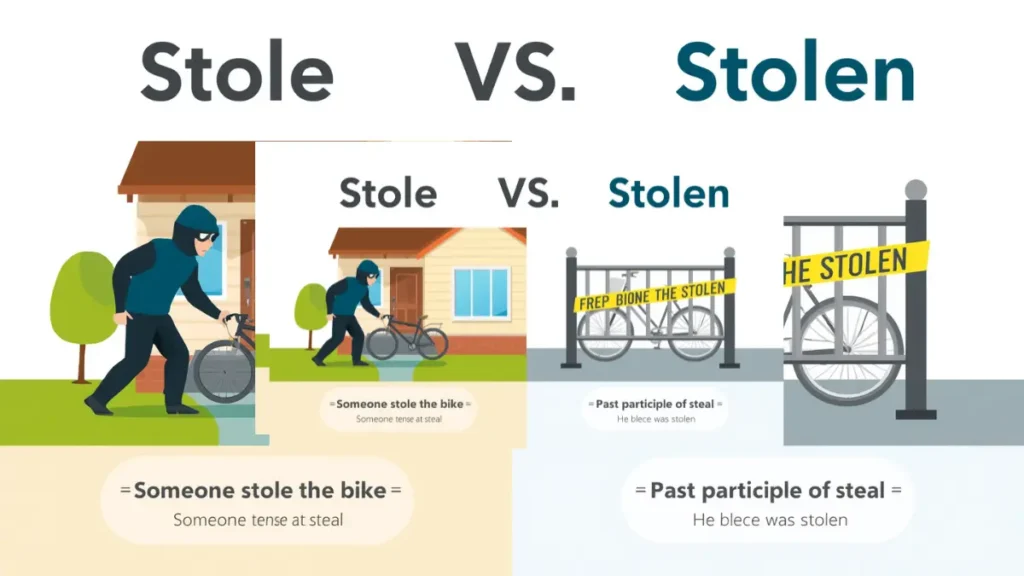
Many people search for “stole or stolen” because these two words look similar but work differently in English. They both come from the verb “steal,” but they are not used in the same way. This confusion is very common for students, writers, and even native speakers.
If you have ever asked yourself, “Should I say someone stole my bag or someone has stolen my bag?” you are not alone. The problem comes from verb tense rules. One word is used in the simple past tense, while the other is used as a past participle.
Learning the difference between “stole” and “stolen” can help you write better emails, speak more clearly, and avoid grammar mistakes in school or work. In this guide, you will get a quick answer, easy examples, spelling and grammar tips, and professional advice on when to use each word correctly.
Stole or Stolen – Quick Answer
“Stole” is the simple past tense of “steal.”
“Stolen” is the past participle of “steal.”
Examples
- Correct: Someone stole my phone yesterday.
- Correct: My phone was stolen yesterday.
- Incorrect: Someone stolen my phone.
- Incorrect: He has stole my wallet.
Simple Rule
- Use stole for past actions.
- Use stolen with helping verbs like:
- has
- have
- had
- was
- were
- Read more: Historical or Historic: What’s the Difference
The Origin of Stole or Stolen
Both “stole” and “stolen” come from the Old English word “stelan,” which means “to take something secretly.”
Over time, English verbs changed forms to show tense.
Verb Forms of “Steal”
| Verb Form | Word |
| Base Verb | steal |
| Past Tense | stole |
| Past Participle | stolen |
English keeps many irregular verbs from older Germanic languages. That is why we say:
- steal → stole → stolen
- break → broke → broken
- choose → chose → chosen
The spelling difference exists because each form has a different grammar job.
British English vs American English Spelling
Unlike many English words, “stole” and “stolen” are spelled the same in both British and American English.
The difference is not about region. It is about grammar and tense.
Examples in British English
- Someone stole my bicycle.
- The jewels were stolen.
Read more: Burnt or Burned: Which Spelling Is Correct?
Examples in American English
- Someone stole my car.
- My laptop was stolen.
Comparison Table
| Usage Type | British English | American English |
| Past Tense | stole | stole |
| Past Participle | stolen | stolen |
| Spelling Difference | None | None |
| Grammar Rules | Same | Same |
So, no matter where you live, the grammar rule stays the same.
Which Spelling Should You Use?
You should not choose between “stole” and “stolen” based on country. You should choose based on sentence structure.
Use “Stole” When:
- The action happened in the past.
- No helping verb is present.
Examples
- The thief stole my watch.
- Someone stole her bike last night.
Use “Stolen” When:
- A helping verb appears before it.
- The sentence uses passive voice or perfect tense.
Examples
- My wallet was stolen.
- Someone has stolen the files.
Audience-Based Advice
| Audience | Best Choice |
| US Readers | Follow grammar tense rules |
| UK Readers | Follow grammar tense rules |
| Global Audience | Use correct verb structure |
Common Mistakes with Stole or Stolen
Many learners mix these words because both refer to theft.
Common Error #1
❌ He has stole my phone.
✅ He has stolen my phone.
Common Error #2
❌ My bag was stole yesterday.
✅ My bag was stolen yesterday.
Common Error #3
❌ Someone stolen my bike.
✅ Someone stole my bike.
Easy Grammar Tip
- “Has,” “have,” and “had” usually need “stolen.”
- Simple past sentences use “stole.”
Stole or Stolen in Everyday Examples
In Emails
- Our company laptop was stolen during our trip.
- Someone stole documents from the office.
In News Headlines
- Police say thieves stole expensive jewelry.
- A stolen car was found downtown.
On Social Media
- Someone stole my idea!
- My account was stolen yesterday.
In Formal Writing
- The confidential files were stolen.
- The suspect allegedly stole company data.
Stole or Stolen – Google Trends & Usage Data
Search data shows that many people look for “stole or stolen” because English learners often confuse verb tenses.
Popular Search Regions
- United States
- United Kingdom
- India
- Pakistan
- Canada
- Australia
Why People Search It
People commonly search this keyword to:
- improve grammar
- prepare for exams
- write correct emails
- avoid speaking mistakes
Usage Context
| Context | Common Form |
| Simple Past | stole |
| Passive Voice | stolen |
| Perfect Tense | stolen |
| News Headlines | both |
| Academic Writing | both |
Comparison Table: Stole vs Stolen
| Feature | Stole | Stolen |
| Grammar Type | Past tense | Past participle |
| Needs Helping Verb | No | Yes |
| Example | He stole my bag. | My bag was stolen. |
| Common Use | Direct action | Passive/perfect tense |
| Formal Writing | Yes | Yes |
FAQs About Stole or Stolen
Is it “has stole” or “has stolen”?
The correct phrase is “has stolen.”
✅ She has stolen the money.
❌ She has stole the money.
Is “stole” past tense?
Yes. “Stole” is the simple past tense of “steal.”
Example:
- Someone stole my phone yesterday.
Is “stolen” a verb?
Yes. “Stolen” is the past participle form of the verb “steal.”
Can I say “was stole”?
No. The correct phrase is “was stolen.”
✅ My car was stolen.
❌ My car was stole.
Why do people confuse stole and stolen?
People confuse them because both words come from “steal” and describe theft. The difference is grammar structure.
Which is more formal: stole or stolen?
Both are formal and correct. The choice depends on sentence structure.
Are stole and stolen different in British English?
No. British and American English use the same spelling and grammar rules for both words.
Conclusion
Understanding the difference between “stole” and “stolen” is important for correct English grammar. Even though the words look similar, they serve different purposes in a sentence. “Stole” is the simple past tense and works alone, while “stolen” is the past participle and needs a helping verb like “has,” “have,” or “was.”
This grammar rule stays the same in British English, American English, and other English-speaking countries. Once you learn the pattern, it becomes much easier to write correct sentences in emails, school work, social media posts, and professional communication.
A simple way to remember the rule is this:
- Use “stole” for direct past actions.
- Use “stolen” with helping verbs.
By practicing real-life examples and avoiding common mistakes, you can use both words confidently and naturally in everyday English.

I am Bahadar Ali, a professional content writer and the author behind GrammarDrive.com. I am passionate about making grammar simple and accessible for everyone. Through my writing, I aim to help learners and professionals communicate with clarity and confidence.