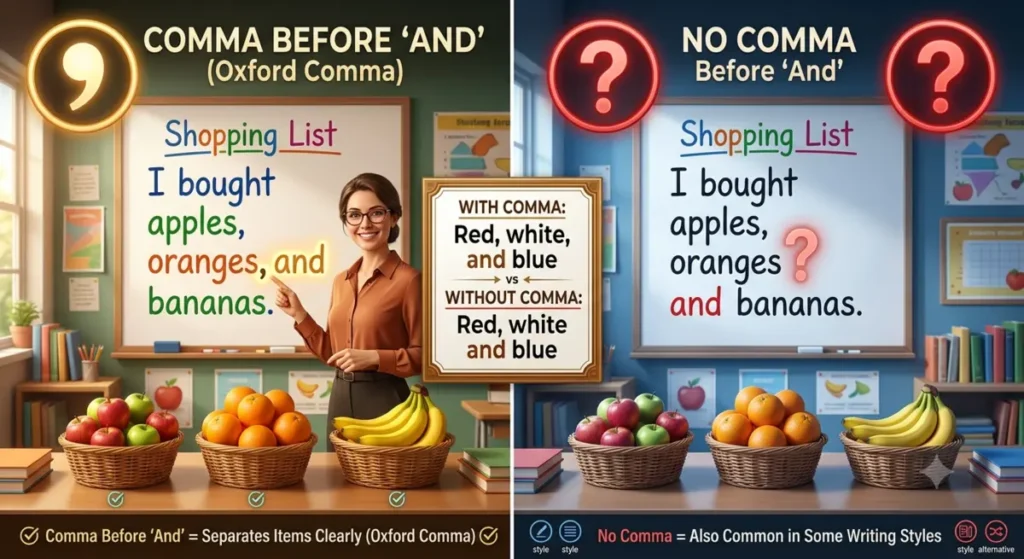
Many writers search for a comma before and comma because they are unsure whether a comma should appear before the word “and.” This small punctuation mark causes a lot of confusion in emails, essays, business writing, and social media posts.
Should you write apples, oranges, and bananas or apples, oranges and bananas? Is one correct and the other wrong? The answer depends on the writing style you use and the audience you write for.
The comma before “and” is often called the Oxford comma or serial comma. Some style guides require it, while others make it optional. Because different countries and publishers follow different rules, many people are unsure which version to choose.
This guide explains everything you need to know about the comma before and comma, including its history, British and American English differences, common mistakes, examples, and professional advice. By the end, you will know exactly when and how to use it.
Comma Before and Comma – Quick Answer
A comma before “and” is usually used in a list of three or more items.
Example with the comma:
- I bought apples, oranges**, and** bananas.
Example without the comma:
- I bought apples, oranges and bananas.
Both forms can be correct depending on the style guide.
In American English, the comma before “and” is commonly preferred. In British English, it is often optional.
Read more:Grammar or Grammarly: Meaning and Correct Usage ?
The Origin of Comma Before and Comma
The comma before “and” has been used for centuries. It became widely known as the Oxford comma because printers and editors at Oxford University Press regularly used it.
The purpose of this comma is simple: it helps separate items in a list and can prevent confusion.
For example:
- I admire my parents, Mother Teresa, and Nelson Mandela.
Without the comma before “and,” readers may think Mother Teresa and Nelson Mandela are the writer’s parents.
The spelling and punctuation differences exist because style guides developed differently in the United States and the United Kingdom. Over time, each region adopted its own preferences.
Read more:Chosing or Choosing: What Is the Correct Spelling ?
British English vs American English Spelling
The main difference is not spelling but punctuation style.
| Feature | American English | British English |
| Oxford comma | Usually preferred | Often optional |
| Example | Red, blue, and green | Red, blue and green |
| Academic writing | Common | Depends on style guide |
| Newspapers | Varies | Often omitted |
| Formal documents | Frequently used | Optional |
American English Example
- We visited Paris, Rome, and Madrid.
British English Example
- We visited Paris, Rome and Madrid.
Both versions are grammatically acceptable.
Which Spelling Should You Use?
The best choice depends on your audience.
For US Readers
Use the Oxford comma.
Example:
- Dogs, cats, and rabbits.
For UK Readers
Follow the style guide you are using.
Example:
- Dogs, cats and rabbits.
For Commonwealth Countries
Australia, New Zealand, and Canada may follow either style depending on the publication.
For Global Audiences
Choose one style and use it consistently throughout your writing.
Consistency is more important than preference.
Common Mistakes with Comma Before and Comma
Mistake 1: Mixing Styles
❌ Apples, oranges, and bananas in one paragraph.
❌ Apples, oranges and bananas in another.
✔ Pick one style and stay consistent.
Mistake 2: Using Too Many Commas
❌ I bought, apples, oranges, and bananas.
✔ I bought apples, oranges, and bananas.
Mistake 3: Forgetting Clarity
❌ I dedicate this book to my parents, Oprah Winfrey and Nelson Mandela.
✔ I dedicate this book to my parents, Oprah Winfrey, and Nelson Mandela.
Mistake 4: Using a Comma with Only Two Items
❌ Bread, and butter.
✔ Bread and butter.
Comma Before and Comma in Everyday Examples
- Please review the report, budget, and schedule.
News Writing
- The meeting included government officials, business leaders and community representatives.
Social Media
- Coffee, music, and a good book make my day.
Formal Writing
- The proposal covers planning, implementation, and evaluation.
Academic Writing
- The study examined age, income, and education level.
Comma Before and Comma – Google Trends & Usage Data
The use of the comma before “and” varies by country and writing context.
Most Common in:
- United States
- Academic institutions
- Legal writing
- Technical writing
Often Optional in:
- United Kingdom
- Journalism
- News publications
- Informal writing
Why It Remains Popular
Many organizations prefer the Oxford comma because it reduces ambiguity and improves clarity. Others omit it to save space and simplify text.
As digital content grows, writers continue to debate whether the comma before “and” should always be used.
Comparison Table: Comma Before “And” Variations
| Style | Example | Common Region |
| Oxford Comma | Red, blue, and green | United States |
| No Oxford Comma | Red, blue and green | United Kingdom |
| Academic Style | Research, analysis, and reporting | Universities |
| Journalism Style | Research, analysis and reporting | Many newspapers |
| Legal Style | Contracts, agreements, and policies | Legal documents |
FAQs
1. What is the comma before “and” called?
It is commonly called the Oxford comma or serial comma.
2. Is the Oxford comma required?
Not always. Some style guides require it, while others make it optional.
3. Do Americans use the Oxford comma?
Yes. American English often prefers the Oxford comma.
4. Do British writers use the Oxford comma?
Sometimes. Many British publications omit it unless clarity requires it.
5. Can leaving out the comma cause confusion?
Yes. In some sentences, omitting it can change the meaning.
6. Should I use the Oxford comma in business writing?
Yes. It improves clarity and helps avoid misunderstandings.
7. Which style is more professional?
Both can be professional if used consistently and according to the chosen style guide.
Conclusion
The comma before and comma question is one of the most common punctuation concerns in English writing. The comma before “and” known as the Oxford comma appears before the final item in a list of three or more items. While American English often favors it, British English frequently treats it as optional.
There is no universal rule that applies to every situation. Instead, writers should follow the style guide used by their school, company, publisher, or audience. The most important rule is consistency. If you use the Oxford comma, use it throughout the document. If you choose not to use it, stay consistent with that choice as well.
In professional, academic, and legal writing, the Oxford comma can improve clarity and reduce confusion. In casual writing, either style may work. Understanding the difference allows you to communicate more clearly and confidently.
Whether you write for US readers, UK readers, or a global audience, knowing when to use the comma before “and” will help make your writing accurate, polished, and easy to understand.

I am Bahadar Ali, a professional content writer and the author behind GrammarDrive.com. I am passionate about making grammar simple and accessible for everyone. Through my writing, I aim to help learners and professionals communicate with clarity and confidence.