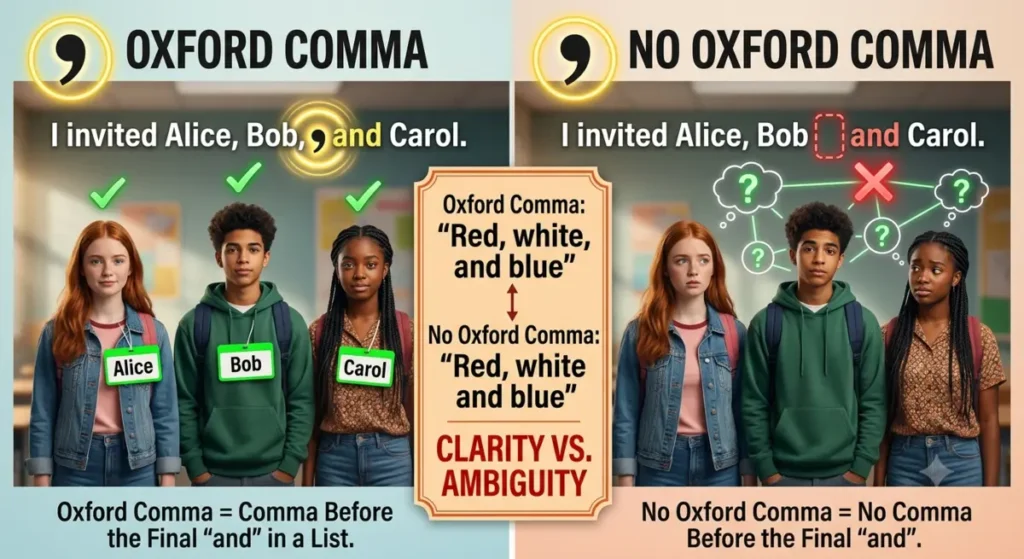
Have you ever wondered whether you should write “red, white, and blue” or “red, white and blue”? This question is at the center of the debate about oxford comma or no oxford comma.
Writers, students, businesses, and editors often search for this topic because different style guides give different advice. Some people believe the Oxford comma makes writing clearer. Others think it adds an unnecessary comma. The confusion becomes even greater when reading British and American English, where punctuation rules can differ.
Understanding the Oxford comma helps you avoid misunderstandings, improve readability, and follow the correct style for your audience. Whether you write emails, blog posts, academic papers, or social media content, knowing when to use the Oxford comma can make your writing look more professional.
In this guide, you’ll learn what the Oxford comma is, where it came from, how it is used in different English-speaking countries, and which style may work best for your writing needs.
Oxford Comma or No Oxford Comma – Quick Answer
The Oxford comma is the comma placed before the final “and” or “or” in a list of three or more items.
With Oxford Comma
- I bought apples, oranges, and bananas.
- We invited Tom, Sarah, and Mike.
Without Oxford Comma
- I bought apples, oranges and bananas.
- We invited Tom, Sarah and Mike.
Quick Explanation
Both styles are generally correct. The main difference is consistency and clarity. American English often prefers the Oxford comma, while British English often leaves it out unless it prevents confusion.
Read more:Requestor or Requester: Meaning & Correct Usage Explained?
The Origin of Oxford Comma or No Oxford Comma
The Oxford comma gets its name from Oxford University Press, which traditionally required writers to use it in publications.
The punctuation itself existed long before Oxford University adopted it. Writers have used commas in lists for centuries. However, style guides eventually split into two groups:
- Those that recommend using the final comma.
- Those that recommend omitting it unless necessary.
The debate continues today because both styles are accepted in many forms of English writing.
Why the Difference Exists
The difference developed through editorial preferences rather than grammar rules. Some publishers valued clarity, while others preferred shorter, cleaner-looking sentences.
As a result, both approaches remain common today.
Read more:Make Do or Make Due: Correct Spelling, and Usage Explained?
British English vs American English Spelling
The Oxford comma debate is closely linked to regional writing styles.
American English
Most American style guides support the Oxford comma.
Examples:
- We studied history, science, and mathematics.
- She likes coffee, tea, and juice.
British English
Many British publishers omit the Oxford comma unless it helps avoid confusion.
Examples:
- We studied history, science and mathematics.
- She likes coffee, tea and juice.
Comparison Table
| Feature | Oxford Comma Style | No Oxford Comma Style |
| Example | Apples, oranges, and bananas | Apples, oranges and bananas |
| Common in US | Yes | Sometimes |
| Common in UK | Sometimes | Yes |
| Academic Writing | Often preferred | Depends on guide |
| Clarity | Usually higher | Can be clear in simple lists |
| Appearance | Slightly longer | Slightly shorter |
Which Spelling Should You Use?
The answer depends on your audience.
For US Readers
Use the Oxford comma.
Many American publishers, universities, and businesses prefer this style.
Example:
- We serve pizza, burgers, and sandwiches.
For UK Readers
Either style may be accepted.
Many British publications omit the Oxford comma unless it improves clarity.
Example:
- We serve pizza, burgers and sandwiches.
For Global Audiences
Consistency matters more than the choice itself.
Pick one style and use it throughout your document.
Professional Advice
If you work with a style guide, follow it. If no guide exists, the Oxford comma is often the safest choice because it can reduce ambiguity.
Common Mistakes with Oxford Comma or No Oxford Comma
Mistake 1: Mixing Styles
❌ We bought apples, oranges and bananas, and grapes.
✅ We bought apples, oranges, bananas, and grapes.
OR
✅ We bought apples, oranges, bananas and grapes.
Mistake 2: Using Random Extra Commas
❌ We invited John, Mary, and, David.
✅ We invited John, Mary, and David.
Mistake 3: Creating Ambiguity
❌ I thank my parents, Oprah Winfrey and Nelson Mandela.
This sentence may suggest Oprah and Nelson Mandela are the writer’s parents.
✅ I thank my parents, Oprah Winfrey, and Nelson Mandela.
Mistake 4: Ignoring Style Guide Rules
Always check the requirements of your school, employer, or publisher.
Oxford Comma or No Oxford Comma in Everyday Examples
Emails
With Oxford Comma
- Please bring notebooks, pens, and calculators.
Without Oxford Comma
- Please bring notebooks, pens and calculators.
News Writing
Many newspapers avoid the Oxford comma to save space.
Example
- The event featured singers, actors and athletes.
Social Media
Both styles appear regularly.
Example
- Weekend plans: movies, snacks, and sleep.
Formal Writing
Academic and business documents often prefer the Oxford comma because it improves clarity.
Example
- The report covers finance, marketing, and operations.
Oxford Comma or No Oxford Comma – Google Trends & Usage Data
Search interest in oxford comma or no oxford comma remains strong because writers continue debating which style is better.
Popular Countries
Interest is highest in:
- United States
- United Kingdom
- Canada
- Australia
- New Zealand
Common Search Intent
People often search:
- What is the Oxford comma?
- Is the Oxford comma required?
- Does British English use the Oxford comma?
- Should I use the Oxford comma in academic writing?
- Which style guide recommends the Oxford comma?
Usage Contexts
The topic is most common in:
- Education
- Publishing
- Journalism
- Business communication
- Content marketing
Oxford Comma Variations Comparison Table
| Variation | Example | Common Region |
| Oxford Comma | Red, blue, and green | United States |
| Serial Comma | Red, blue, and green | Alternative name |
| No Oxford Comma | Red, blue and green | United Kingdom |
| Optional Oxford Comma | Used only for clarity | Mixed usage |
| Style Guide-Based Usage | Depends on guide | Global |
Frequently Asked Questions
1. What is the Oxford comma?
The Oxford comma is the comma placed before the final “and” or “or” in a list of three or more items.
2. Is the Oxford comma grammatically correct?
Yes. It is completely correct and widely accepted.
3. Do Americans use the Oxford comma?
Yes. Most American style guides recommend it.
4. Do British writers use the Oxford comma?
Some do, but many British publications omit it unless needed for clarity.
5. Does the Oxford comma prevent confusion?
Yes. In some sentences, it can remove ambiguity and improve understanding.
6. Should I use the Oxford comma in academic writing?
Many universities and academic style guides recommend using it consistently.
7. Is it wrong not to use the Oxford comma?
No. Many respected publications do not use it. Consistency is the key.
Conclusion
The debate over oxford comma or no oxford comma has continued for many years, but the good news is that both styles are generally acceptable. The Oxford comma adds a comma before the final item in a list, while the no-Oxford-comma style leaves it out. Neither approach is universally right or wrong.
The best choice depends on your audience, location, and style guide. American English typically favors the Oxford comma, while British English often omits it. For global communication, consistency is more important than the specific choice you make.
Many writers prefer the Oxford comma because it can improve clarity and prevent misunderstandings. Others choose to omit it for a cleaner appearance. Whichever style you select, apply it consistently throughout your writing.
If you are unsure, using the Oxford comma is often the safest option because it rarely causes confusion and frequently helps readers understand your meaning more quickly.

I am Bahadar Ali, a professional content writer and the author behind GrammarDrive.com. I am passionate about making grammar simple and accessible for everyone. Through my writing, I aim to help learners and professionals communicate with clarity and confidence.