Have you ever wondered whether you should use parentheses or brackets in your writing? Many people search for this topic because the two punctuation marks look similar and are often confused. Students, writers, editors, and professionals frequently ask which one is correct and when each should be used.
The confusion usually comes from the fact that both punctuation marks add extra information to a sentence. However, they serve different purposes. Using the wrong one can make your writing look unclear or even incorrect.
The good news is that understanding the difference is simple. Parentheses and brackets each have their own role in grammar, academic writing, journalism, and everyday communication. Once you learn the basic rules, choosing the right punctuation becomes easy.
This guide provides a quick answer, detailed explanations, practical examples, common mistakes, and expert advice so you can confidently decide when to use parentheses or brackets in any situation.
Parentheses or Brackets – Quick Answer
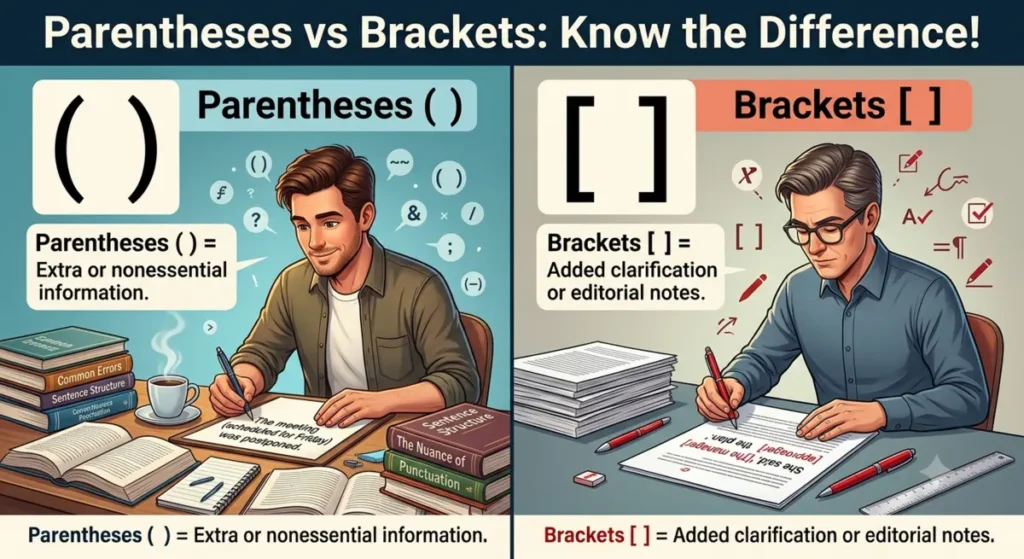
Parentheses ( ) are used to add extra information, comments, or explanations that are not essential to the main sentence.
Brackets [ ] are used to add clarifications, corrections, or editorial notes within quoted material.
Examples
Parentheses:
- The meeting starts at 9 a.m. (please arrive early).
- Sara moved to London (England’s capital) last year.
Brackets:
- The witness said, “He [the driver] left the scene immediately.”
- The report stated, “Sales increased by 20% [in 2024].”
Read more:Role or Roll: What’s Difference and Which Word You Use?
Quick Comparison
| Punctuation | Symbol | Main Purpose |
| Parentheses | ( ) | Add extra information |
| Brackets | [ ] | Add clarification inside quotes |
The Origin of Parentheses or Brackets
The word parenthesis comes from the Greek word parentithenai, meaning “to put beside.” Parentheses have been used for centuries to insert extra thoughts or information into writing.
The word bracket comes from French and English terms used to describe supporting structures. In writing, brackets became useful for editors and scholars who needed to insert explanations into quoted text.
Unlike many English words, there is no spelling difference between British and American English for parentheses and brackets. The difference is in their function rather than their spelling.
Over time, writing styles became standardized, and modern grammar guides now clearly distinguish when each punctuation mark should be used.
Read more:Comma or Semicolon: What’s Difference and When You Use?
British English vs American English Spelling
There is no major spelling difference between British and American English for these punctuation marks. However, usage terminology can differ slightly.
Comparison Table
| British English | American English | Meaning |
| Brackets | Parentheses (sometimes) | Refers to ( ) in some contexts |
| Square Brackets | Brackets | Refers to [ ] |
| Parentheses | Parentheses | Extra information in text |
| Brackets | Brackets | Editorial additions in quotes |
Example
British Style:
- The package arrived yesterday (a day early).
American Style:
- The package arrived yesterday (a day early).
The punctuation remains the same. Only terminology may vary in certain style guides.
Which Spelling Should You Use?
Since there is no spelling difference, the choice depends on understanding the punctuation marks correctly.
If Your Audience Is in the United States
- Use parentheses ( ) for extra information.
- Use brackets [ ] for clarifications in quotations.
If Your Audience Is in the United Kingdom
- Follow the same punctuation rules.
- Be aware that some British guides may refer to parentheses as brackets.
If Your Audience Is Global
- Use the standard grammar rules accepted internationally.
- Keep punctuation consistent throughout your document.
The safest approach is to follow modern style guides and use each punctuation mark for its intended purpose.
Common Mistakes with Parentheses or Brackets
Many writers make these common errors:
| Incorrect Usage | Correct Usage |
| He left early [because he was tired]. | He left early (because he was tired). |
| “The teacher [was absent].” | “The teacher was absent.” |
| “She [Mary] arrived late.” | Correct if clarification is needed. |
| The event [scheduled for Friday] was canceled. | The event (scheduled for Friday) was canceled. |
Frequent Errors
- Using brackets instead of parentheses for extra information.
- Adding brackets where no quotation exists.
- Mixing parentheses and brackets incorrectly.
- Overusing punctuation and making sentences difficult to read.
- Forgetting to close punctuation marks.
Parentheses or Brackets in Everyday Examples
Emails
Parentheses:
- I’ll send the report tomorrow (after the final review).
Brackets:
- The client wrote, “Please contact [John Smith] for updates.”
News Articles
Parentheses:
- The company announced a new office (its third this year).
Brackets:
- The spokesperson said, “We expect growth [in Asia] next quarter.”
Social Media
Parentheses:
- Great game today (best match of the season)!
Formal Writing
Parentheses:
- The experiment produced positive results (see Appendix A).
Brackets:
- The author stated, “The findings [from 2023] were significant.”
Parentheses or Brackets – Google Trends & Usage Data
Search interest for parentheses or brackets remains steady because students, writers, and English learners often need punctuation guidance.
Popular Countries for Searches
- United States
- United Kingdom
- Canada
- Australia
- India
Common Search Contexts
- Grammar lessons
- Academic writing
- Editing and proofreading
- Journalism
- Business communication
Usage Comparison Table
| Term | Common Usage |
| Parentheses | Extra information |
| Brackets | Clarifications in quotations |
| Round Brackets | Alternative name for parentheses |
| Square Brackets | Alternative name for brackets |
In everyday writing, parentheses appear much more frequently than brackets because writers often need to add extra details.
Frequently Asked Questions
1. What is the difference between parentheses and brackets?
Parentheses add extra information, while brackets add clarifications or editorial notes inside quotations.
2. When should I use parentheses?
Use parentheses when adding information that is helpful but not essential to the sentence.
3. When should I use brackets?
Use brackets when inserting explanations, corrections, or notes into quoted text.
4. Can I use brackets instead of parentheses?
Generally, no. Each punctuation mark has a specific purpose.
5. Which is more common in everyday writing?
Parentheses are much more common because they are used for additional information.
6. Are parentheses and brackets the same thing?
No. They look similar but have different grammatical functions.
7. Do British and American English use them differently?
The punctuation rules are mostly the same, though terminology may vary slightly.
Conclusion
Understanding parentheses or brackets is easier than many people think. The key difference is simple: parentheses provide extra information, while brackets provide clarification inside quoted material. Once you remember this rule, choosing the correct punctuation becomes straightforward.
Parentheses are commonly used in emails, articles, reports, and everyday writing. They allow writers to include helpful details without interrupting the main sentence. Brackets, on the other hand, are mainly used by editors, journalists, researchers, and academics when modifying or explaining quoted text.
There is no major spelling difference between British and American English for these punctuation marks. The real focus should be on using each one correctly according to its purpose. By avoiding common mistakes and following standard grammar rules, you can make your writing clearer, more professional, and easier to understand.
Whether you are writing a school assignment, business document, social media post, or news article, knowing when to use parentheses and brackets will improve your communication and help your message appear polished and accurate.

I am Arshman Ali a professional English writer and English professor with a passion for language and a commitment to excellence. I bring precision and clarity to my writing, and the same high standards into my classroom. For me, language is not just a profession it is a purpose.