Many writers get confused about comma or semicolon usage. Both punctuation marks help connect ideas, but they work in different ways. A comma is common and simple. A semicolon is stronger and more formal. Because they look similar in sentences, people often mix them up.
This confusion happens in emails, essays, blog posts, and even social media captions. Some people use commas where semicolons should go. Others avoid semicolons completely because they seem hard to use. That is why many users search for “comma or semicolon” online. They want a quick answer and easy examples.
The good news is that the difference is simple once you understand the basic rule. A comma separates smaller parts of a sentence. A semicolon connects two complete ideas that are closely related.
In this guide, you will learn the meaning of commas and semicolons, their history, British and American usage, common mistakes, examples, and professional writing tips.
Comma or Semicolon – Quick Answer
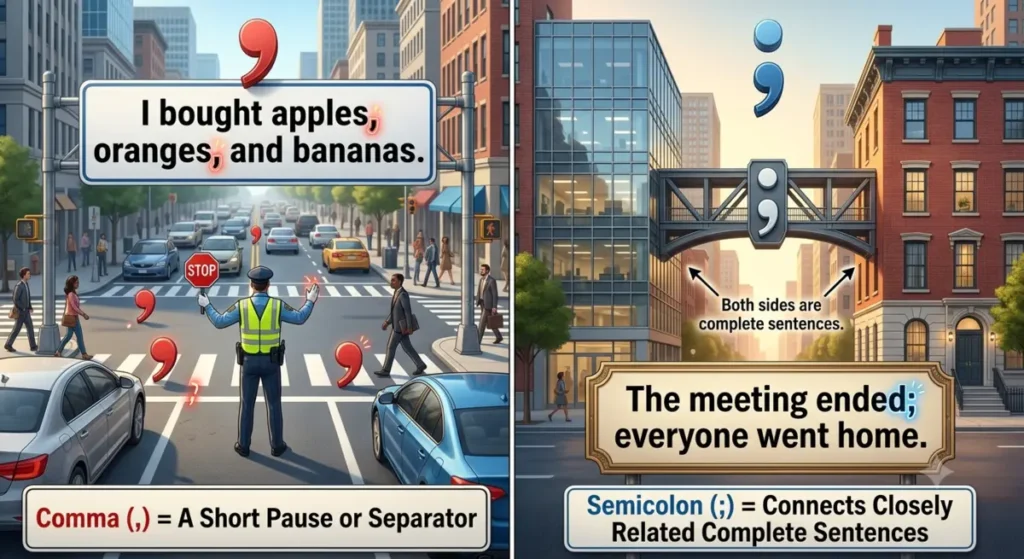
A comma (,) separates words, phrases, or clauses inside a sentence.
A semicolon (;) connects two complete sentences that are closely related.
Examples
Comma Example:
- I bought apples, oranges, and bananas.
Semicolon Example:
- I bought apples today; they were very fresh.
Simple Rule
Use a comma for short pauses.
Use a semicolon to join related complete thoughts.
Read more:To Much or Too Much: Which One Is Correct?
The Origin of Comma or Semicolon
The comma comes from the Greek word komma, meaning “piece cut off.” Writers used it to show short pauses in speech and writing.
The semicolon appeared later in the 15th century. Italian printer Aldus Manutius introduced it to connect ideas more clearly than a comma could.
Over time, punctuation rules became more organized. Today, commas are used in everyday writing, while semicolons are common in formal or academic writing.
The spelling of “comma” and “semicolon” does not change between countries. However, punctuation style and usage can differ slightly between British and American English.
Read more:Boxers or Briefs: Which One Should You Choose?
British English vs American English Spelling
The words comma and semicolon are spelled the same in British and American English. The main difference is punctuation style.
For example, American English often places commas and periods inside quotation marks. British English may place them outside if they are not part of the original quote.
Examples
| Style | American English | British English |
| Comma with quotes | “I agree,” she said. | “I agree”, she said. |
| Semicolon usage | Common in formal writing | Also common in formal writing |
| Oxford comma | Often preferred | Sometimes optional |
Comparison Table
| Punctuation | Symbol | Main Use | Example |
| Comma | , | Separate items or clauses | I like tea, coffee, and juice. |
| Semicolon | ; | Connect related sentences | I like tea; coffee keeps me awake. |
Which Spelling Should You Use?
Since the spelling is the same everywhere, the real question is about style and punctuation rules.
For American Audiences
Use American punctuation style:
- Periods and commas usually go inside quotation marks.
- Semicolons are common in formal writing.
For British or Commonwealth Audiences
Use British punctuation style:
- Quotation punctuation may vary.
- Semicolons are often used carefully in academic writing.
For Global Audiences
Keep your writing simple:
- Use commas more often for clarity.
- Use semicolons only when needed.
- Avoid overly long sentences.
Simple punctuation works best for blogs, websites, and online readers.
Common Mistakes with Comma or Semicolon
Many writers misuse commas and semicolons. Here are common mistakes.
1. Using a Comma Between Two Full Sentences
❌ I was tired, I went to sleep.
✅ I was tired, so I went to sleep.
✅ I was tired; I went to sleep.
2. Using a Semicolon Instead of a Comma in Lists
❌ I bought milk; bread; eggs.
✅ I bought milk, bread, and eggs.
3. Avoiding Semicolons Completely
Some writers never use semicolons. That is okay in casual writing, but semicolons improve formal writing.
4. Overusing Semicolons
❌ The weather was cold; the store was busy; I drank coffee.
✅ The weather was cold, and the store was busy. I drank coffee.
Comma or Semicolon in Everyday Examples
Emails
- Please send the files, and I will review them.
- The report is finished; I will send it tonight.
News Writing
- The president visited France, Germany, and Italy.
- The storm caused damage; emergency teams responded quickly.
Social Media
- Pizza, movies, and friends make the perfect weekend.
- I wanted to quit; instead, I kept going.
Formal Writing
- The study included adults, teenagers, and children.
- The results were surprising; further research is needed.
Comma or Semicolon – Google Trends & Usage Data
Search interest for comma or semicolon is high among:
- Students
- Bloggers
- Business writers
- English learners
Popular Countries
People in these countries often search for punctuation help:
- United States
- United Kingdom
- Canada
- Australia
- India
Usage Trends
- Comma is far more common in daily writing.
- Semicolon appears more in academic and professional content.
- Online writing trends favor shorter sentences and fewer semicolons.
Many modern writers prefer simple punctuation because it improves readability on phones and websites.
Comparison Table: Comma vs Semicolon
| Feature | Comma | Semicolon |
| Symbol | , | ; |
| Strength | Weak pause | Strong pause |
| Use | Separate parts | Join related sentences |
| Common in casual writing | Yes | Less common |
| Common in formal writing | Yes | Yes |
| Example | I ran, and I won. | I ran fast; I still lost. |
FAQs About Comma or Semicolon
1. What is the main difference between a comma and a semicolon?
A comma separates sentence parts, while a semicolon joins two related complete sentences.
2. Can I replace a semicolon with a comma?
Not always. A comma alone cannot join two full sentences correctly.
3. Is semicolon use old-fashioned?
No. Semicolons are still common in formal and professional writing.
4. Which is stronger: comma or semicolon?
A semicolon creates a stronger pause than a comma.
5. Should I use semicolons in emails?
Yes, but only in formal or professional emails.
6. Do British and American English use semicolons differently?
The rules are mostly the same, but punctuation style around quotation marks may differ.
7. Can a semicolon replace a period?
Sometimes. It can connect two closely related sentences instead of separating them fully.
Conclusion
Understanding comma or semicolon usage can make your writing clearer and more professional. A comma helps separate small parts of a sentence, lists, and ideas. A semicolon connects two complete thoughts that are closely related. Both punctuation marks are important, but they serve different purposes.
Many writers overuse commas or avoid semicolons because the rules seem confusing. In reality, the difference is simple. If your sentence contains two full ideas that belong together, a semicolon may work well. If you only need a short pause or list separator, use a comma.
British and American English spell these punctuation names the same way, though style rules can vary slightly. For global readers, simple punctuation is usually best.
The easiest way to improve is by reading examples and practicing often. With time, choosing between a comma and semicolon becomes natural and easy.

I am Bahadar Ali, a professional content writer and the author behind GrammarDrive.com. I am passionate about making grammar simple and accessible for everyone. Through my writing, I aim to help learners and professionals communicate with clarity and confidence.