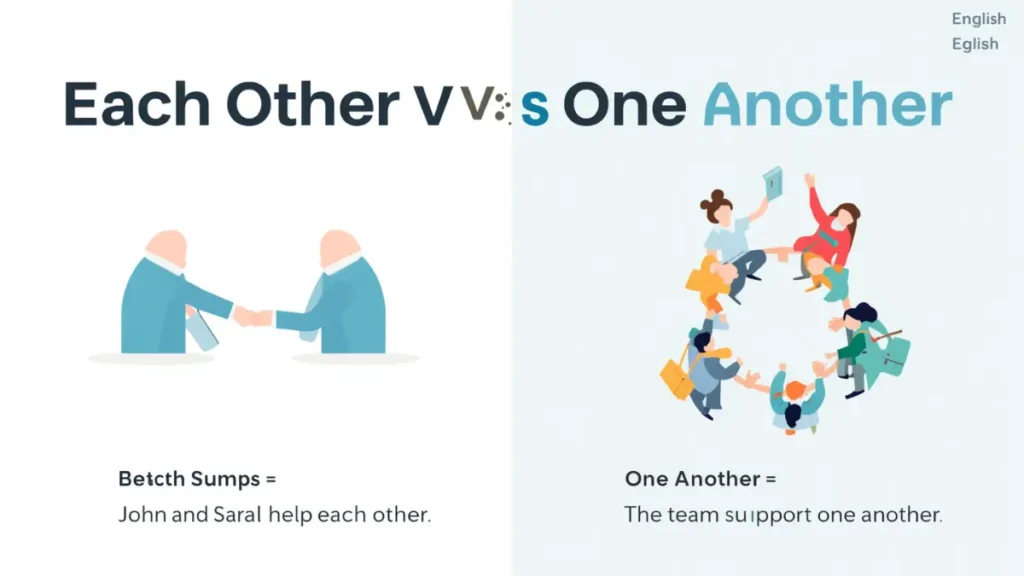
Many English learners and writers wonder whether they should use each other or one another. At first glance, both phrases seem to mean the same thing. They both describe a mutual action or feeling shared between people. Because of this, many people use them interchangeably.
You may have seen sentences like “The friends helped each other” and “The friends helped one another.” Both sound correct, but is there a real difference?
Traditionally, grammar books suggested using each other for two people and one another for three or more people. However, modern English has become more flexible, and many writers now use both expressions in similar ways.
This guide explains the meanings, origins, usage rules, common mistakes, and examples of each other and one another. By the end, you will know when to use each phrase and how to write with confidence in both formal and everyday English.
Each Other or One Another – Quick Answer
Each other and one another both mean that two or more people do something mutually.
Examples
✅ Sarah and John helped each other.
✅ Sarah and John helped one another.
✅ The team members supported each other.
✅ The team members supported one another.
Traditional Rule
- Each other = two people.
- One another = three or more people.
Modern Rule
In modern English, both phrases are usually accepted for two or more people.
Read more: Its or It’s: What’s the Difference and Which One Is Correct?
The Origin of Each Other or One Another
Both expressions have existed in English for hundreds of years.
Each Other
The phrase each developed from the words each and other. It was commonly used to describe mutual actions between two individuals.
One Another
The phrase one another combines one and another. Historically, it was used when more than two people shared a mutual action.
Why the Confusion Exists
The confusion comes from changing language habits. Older grammar guides made a clear distinction between the two phrases. Modern usage has blurred that line, and many professional writers treat them as interchangeable.
British English vs American English Spelling
There is no spelling difference between each other and one another in British and American English.
Read more: Learnt or Learned: Which Spelling Is Correct ?
Comparison Table
| Meaning | British English | American English |
| Mutual action | Each other | Each other |
| Mutual action | One another | One another |
Examples
| British English | American English |
| They respect each other. | They respect each other. |
| They respect one another. | They respect one another. |
The spelling remains the same worldwide.
Which Spelling Should You Use?
Since there is no spelling difference, your choice depends on style and audience.
For US Audiences
Both each other and one another are acceptable.
For UK Audiences
Both forms are commonly used and understood.
For Global Audiences
Use whichever sounds more natural in your sentence.
Professional Advice
- Use each other for simple, everyday writing.
- Use one another when you want a slightly more formal tone.
Common Mistakes with Each Other or One Another
Mistake 1: Thinking Only One Is Correct
❌ They helped each other. (Wrong according to some people)
✅ They helped each other.
✅ They helped one another.
Both are acceptable in modern English.
Mistake 2: Overusing Traditional Rules
❌ The team members supported each other. (Some think this is wrong because there are more than two people.)
✅ The team members supported each other.
Modern grammar accepts this usage.
Mistake 3: Using Them Without Mutual Meaning
❌ Sarah helped each other.
✅ Sarah and John helped each other.
The phrase requires at least two people.
Quick Correction Table
| Incorrect | Correct |
| Sarah helped each other. | Sarah and John helped each other. |
| John thanked one another. | John and Sarah thanked one another. |
| Team supported each other (marked wrong) | The team supported each other. |
Each Other or One Another in Everyday Examples
Emails
“We should support each other during this project.”
“We should support one another during this project.”
News Writing
“The leaders agreed to work with each other.”
“The nations promised to help one another.”
Social Media
“We always encourage each other.”
“We lift one another up every day.”
Formal Writing
“The participants respected one another throughout the study.”
“The partners trusted each other during negotiations.”
Each Other or One Another – Google Trends & Usage Data
Both phrases remain popular across English-speaking countries.
Each Other
- More common in everyday speech.
- Frequently used in conversation.
- Popular in social media and blogs.
One Another
- More common in formal writing.
- Often appears in books, academic papers, and speeches.
Usage by Country
| Country | Each Other | One Another |
| United States | Very High | High |
| United Kingdom | Very High | High |
| Canada | High | Moderate |
| Australia | High | Moderate |
| New Zealand | High | Moderate |
Overall, each other is slightly more common in everyday communication.
Each Other vs One Another Comparison Table
| Feature | Each Other | One Another |
| Meaning | Mutual action | Mutual action |
| Traditional Use | Two people | Three or more people |
| Modern Use | Two or more people | Two or more people |
| Formality | Less formal | Slightly more formal |
| British English | Same spelling | Same spelling |
| American English | Same spelling | Same spelling |
| Everyday Usage | Very common | Common |
FAQs
1. What is the difference between each other and one another?
Traditionally, each other was used for two people and one another for three or more. Today, both are usually acceptable.
2. Can I use each other for more than two people?
Yes. Modern English widely accepts this usage.
3. Is one another more formal?
Yes. Many writers feel that one another sounds slightly more formal.
4. Which phrase is more common?
Each other is generally more common in everyday conversation and online writing.
5. Do British and American English use different spellings?
No. The spelling is the same in both varieties.
6. Are each other and one another interchangeable?
In most modern situations, yes.
7. Which should I use in professional writing?
Either is correct, but one another may sound more formal in some contexts.
Conclusion
The choice between each other and one another is much simpler than many people think. Both expressions describe mutual actions, feelings, or relationships between people. While traditional grammar rules suggested using each other for two people and one another for groups of three or more, modern English no longer follows this distinction strictly.
Today, most writers, editors, and style guides accept both phrases in similar situations. The difference is usually one of style rather than grammar. Each other feels more natural and conversational, while one another often sounds slightly more formal and polished.
Since there are no spelling differences between British and American English, your decision should be based on tone and audience rather than location. For everyday communication, each other is often the easiest choice. For formal documents, reports, or speeches, one another may add a more professional feel.
Understanding this small grammar point can make your writing smoother, clearer, and more confident in every situation.

I am Arshman Ali a professional English writer and English professor with a passion for language and a commitment to excellence. I bring precision and clarity to my writing, and the same high standards into my classroom. For me, language is not just a profession it is a purpose.