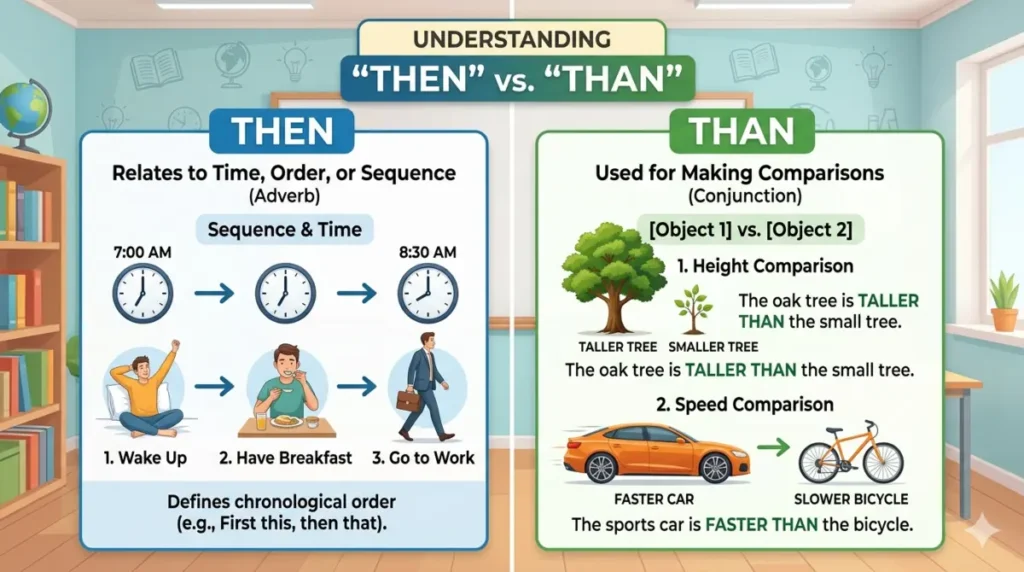
Many people confuse then or than because the words look similar and sound close in fast speech. Still, they have very different meanings. One small spelling mistake can completely change a sentence. For example, “She is taller then me” is incorrect, while “She is taller than me” is correct.
People search for then or than because these words are common in emails, essays, social media posts, and school writing. Students, writers, and even native English speakers often mix them up. The confusion usually happens because both words are short and frequently used in everyday English.
The good news is that the difference is simple once you understand the basic rule. “Than” is mainly used for comparisons, while “then” relates to time, order, or what happens next. This guide explains then or than with easy examples, grammar tips, comparison tables, and common mistakes. By the end, you will know exactly when to use each word confidently.
Then or Than – Quick Answer
Quick Rule
- Than = used for comparison
- Then = used for time or sequence
Examples
| Word | Example |
| Than | Ali is taller than Ahmed. |
| Then | We ate dinner, then watched a movie. |
Simple Memory Trick
- Than compare things.
- Then tell when something happens.
Read more: Burnt or Burned: Which Spelling Is Correct?
The Origin of Then or Than
The words then and than come from Old English. Long ago, they were closely related in spelling and pronunciation. Over time, English grammar changed, and the words developed different meanings.
- Than became the word used for comparisons.
- Then it became linked to time and sequence.
Historical Development
| Word | Original Meaning |
| Than | Comparison |
| Then | Time or next step |
Because the words evolved from similar roots, many people still confuse them today.
British English vs American English Spelling
Unlike words such as “colour” and “color,” there is no major spelling difference between British and American English for then or than.
Both countries use:
- then
- than
The real difference is grammar and meaning, not regional spelling.
Read more: Learnt or Learned: Which Spelling Is Correct ?
Comparison Table
| Usage | British English | American English |
| Comparison | than | than |
| Time/order | then | then |
Examples
| Sentence Type | Example |
| Comparison | Tea is healthier than soda. |
| Time sequence | Finish your work, then relax. |
Which Spelling Should You Use?
The choice depends on the meaning of your sentence, not your audience location.
Use “Than” When:
- Comparing people or things
- Showing differences
- Talking about amounts or sizes
Examples
- She is smarter than me.
- This car is faster than that one.
Use “Then” When:
- Talking about time
- Explaining order
- Showing what happens next
Examples
- We went shopping, then came home.
- Finish lunch, then start work.
Best Advice for Global Writing
Always check:
- Are you comparing? → use than
- Are you talking about time? → use then
Common Mistakes with Then or Than
These mistakes are very common in English writing.
| Incorrect | Correct |
| He is older then me. | He is older than me. |
| First study, than sleep. | First study, then sleep. |
| I would rather walk then drive. | I would rather walk than drive. |
Mistake 1: Using “then” in comparisons
Wrong:
- Better then before
Correct:
- Better than before
Mistake 2: Using “than” for time order
Wrong:
- We ate breakfast than left.
Correct:
- We ate breakfast then left.
Mistake 3: Typing too quickly
Many errors happen because of autocorrect or fast typing.
Then or Than in Everyday Examples
In Emails
- “Please finish the report, then send it.”
- “This option is cheaper than the first one.”
In News Writing
- “The storm was stronger than expected.”
- “The president spoke, then left the stage.”
On Social Media
- “Life feels better than ever.”
- “I woke up late, then missed the bus.”
In Formal Writing
- “The second method performed better than the first.”
- “The experiment began, then results were recorded.”
Then or Than – Google Trends & Usage Data
Search data shows that many people look up then or than because it is one of the most common English grammar mistakes online.
Usage by Context
| Word | Common Context |
| Than | Comparisons |
| Then | Time and sequence |
Popular Searches
People often search:
- “better then or than”
- “rather then or than”
- “first this then that”
Country Trends
| Country | Common Issue |
| United States | Comparison mistakes |
| United Kingdom | Typing confusion |
| Canada | Grammar learning |
| Australia | School writing questions |
Then vs Than Comparison Table
| Feature | Then | Than |
| Main Meaning | Time/order | Comparison |
| Part of Speech | Adverb | Conjunction/preposition |
| Used in Comparisons | No | Yes |
| Used for Sequence | Yes | No |
| Example | Eat, then sleep. | Bigger than before. |
FAQs About Then or Than
1. What is the difference between then and than?
“Than” compares things. “Then” shows time or sequence.
2. Is it better then or better than?
Correct phrase:
- better than
3. Can then be used for comparison?
No. Comparisons use “than.”
4. Why do people confuse then and than?
Because the words look and sound similar.
5. Is then related to time?
Yes. “Then” refers to time, order, or what happens next.
6. Is than a conjunction?
Yes. It is commonly used in comparisons.
7. How can I remember the difference?
Think:
- “A” in than = compare
- “E” in then = time events
Conclusion
Understanding then or then becomes easy once you remember their main functions. “Than” is used for comparisons, while “then” relates to time, sequence, or the next step in a process. Although the words look similar, they serve very different grammar purposes.
Many writers make mistakes with these terms in emails, essays, social media posts, and professional writing. A small error can make a sentence look confusing or unprofessional. That is why learning the difference matters.
The best way to avoid mistakes is to stop and check your sentences carefully. If you compare two things, use “than.” If you describe what happens next, use “then.” With practice, choosing the correct word will become natural.
Mastering small grammar details like then or than improves your writing clarity, confidence, and communication skills in both formal and casual English.

I am Arshman Ali a professional English writer and English professor with a passion for language and a commitment to excellence. I bring precision and clarity to my writing, and the same high standards into my classroom. For me, language is not just a profession it is a purpose.