Many writers struggle with colon or semicolon rules. These punctuation marks look similar, but they do very different jobs in a sentence. Students, bloggers, business writers, and even native English speakers often confuse them.
People search for “colon or semicolon” because they want a quick and simple answer. They may wonder where to place each mark, how grammar rules work, or which one sounds more professional in writing.
The confusion happens because both punctuation marks connect ideas. But the meaning changes depending on which one you use. A colon introduces information. A semicolon links related sentences. Using the wrong one can make writing unclear or awkward.
This guide explains everything in simple words. You will learn the difference between a colon and a semicolon, their history, grammar rules, common mistakes, and real-life examples. You will also see comparison tables, usage tips, and answers to common questions.
By the end, you will know exactly when to use a colon and when to use a semicolon with confidence.
Colon or Semicolon – Quick Answer
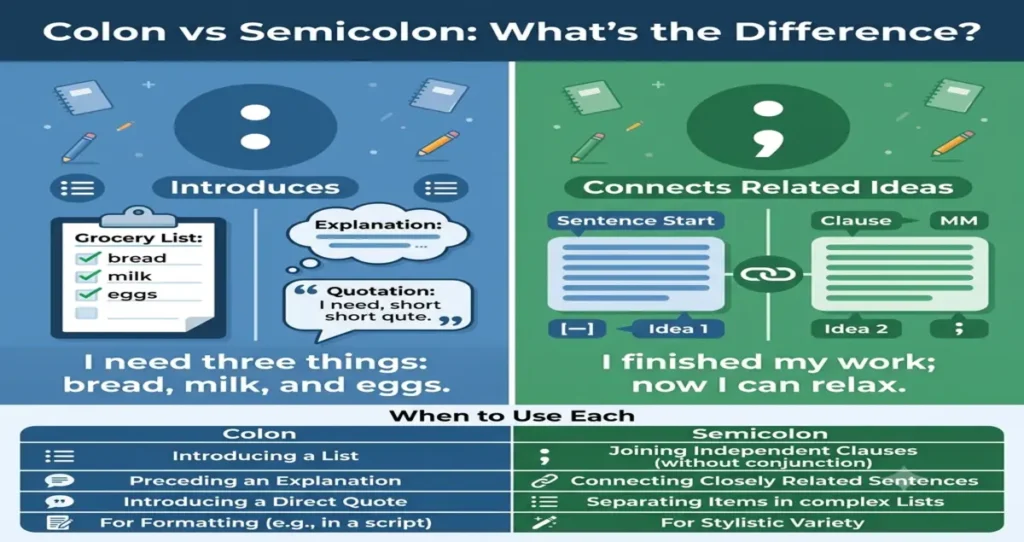
A colon (:) introduces information, lists, explanations, or examples.
Colon Example
I need three things: bread, milk, and eggs.
A semicolon (;) connects two closely related independent sentences.
Semicolon Example
I wanted to go outside; it started raining.
Read more:Setup or Set Up: What’s the Difference and Which One Should?
Quick Difference
| Colon (:) | Semicolon (;) |
| Introduces information | Connects related sentences |
| Used before lists | Used between complete thoughts |
| Signals explanation | Signals close relationship |
The Origin of Colon or Semicolon
The colon and semicolon both come from ancient Greek and Latin writing systems.
Origin of the Colon
The word colon comes from the Greek word kōlon, meaning “part of a sentence.” Ancient writers used it to show pauses while reading aloud.
Over time, the colon became a punctuation mark used before explanations, lists, and quotations.
Origin of the Semicolon
The semicolon was invented later. An Italian printer named Aldus Manutius introduced it in the late 1400s.
The semicolon helped writers connect related thoughts without ending the sentence completely.
Why the Difference Exists
The colon creates a strong stop before extra information. The semicolon creates a softer break between connected ideas.
That is why they look similar but serve different purposes in grammar.
Read more:Requester or Requestor: Which Spelling Is Correct?
British English vs American English Spelling
Unlike words such as “colour” and “color,” the punctuation names colon and semicolon stay the same in both British and American English.
However, writing style rules can differ slightly.
American English Style
American writing often uses shorter sentences. Because of this, semicolons appear less often in casual writing.
British English Style
British English sometimes uses semicolons more frequently in formal writing and literature.
Comparison Table
| Feature | American English | British English |
| Colon spelling | Colon | Colon |
| Semicolon spelling | Semicolon | Semicolon |
| Informal use | Less common | Slightly more common |
| Formal writing | Common | Common |
Which Spelling Should You Use?
You do not need to change spelling for different audiences because both forms stay the same worldwide.
Use for American Audiences
Follow standard American punctuation style guides like AP or Chicago Manual of Style.
Use for British or Commonwealth Audiences
Follow UK grammar conventions, especially in academic or formal writing.
Use for Global Audiences
Keep sentences simple. Avoid too many semicolons if readers are non-native English speakers.
Best Advice
- Use colons for lists and explanations.
- Use semicolons for linking related ideas.
- Keep punctuation simple for online readers.
Common Mistakes with Colon or Semicolon
Many writers misuse these punctuation marks. Here are the most common errors.
Mistake 1: Using a Semicolon Before a List
❌ I bought fruit; apples, bananas, and grapes.
✅ I bought fruit: apples, bananas, and grapes.
Mistake 2: Using a Colon Between Two Full Sentences Incorrectly
❌ She loves music: she plays piano daily.
✅ She loves music; she plays piano daily.
Mistake 3: Using a Semicolon with Incomplete Sentences
❌ Because I was late; I missed the bus.
✅ Because I was late, I missed the bus.
Mistake 4: Overusing Semicolons
Too many semicolons can make writing feel old-fashioned or difficult to read.
Colon or Semicolon in Everyday Examples
In Emails
Colon Example
Please bring the following items: laptop, charger, and notebook.
Semicolon Example
The meeting ended early; everyone went home happy.
In News Writing
Colon Example
The mayor announced one major change: lower taxes.
Semicolon Example
The storm caused flooding; many roads closed overnight.
On Social Media
Colon Example
Today’s goals: study, exercise, and relax.
Semicolon Example
I wanted coffee; the café was closed.
In Formal Writing
Colon Example
There is one reason for success: consistency.
Semicolon Example
The results improved significantly; the team celebrated the achievement.
Colon or Semicolon – Google Trends & Usage Data
Search interest for “colon or semicolon” remains high because students and professionals often need grammar help.
Popular Countries for Searches
- United States
- United Kingdom
- Canada
- Australia
- India
Why People Search This Keyword
People usually search this topic for:
- Homework help
- Business writing
- Academic grammar
- Content writing
- Punctuation correction
Usage Trends
- Colons are more common in digital content.
- Semicolons appear more in formal and academic writing.
- Online writing favors shorter sentences and fewer semicolons.
Colon vs Semicolon Comparison Table
| Feature | Colon (:) | Semicolon (;) |
| Main Purpose | Introduce information | Connect related sentences |
| Used Before Lists | Yes | No |
| Used Between Full Sentences | Sometimes | Yes |
| Formal Writing | Very common | Common |
| Informal Writing | Common | Less common |
| Example | She bought food: rice and beans. | She bought food; she cooked dinner later. |
FAQs About Colon or Semicolon
What is the main difference between a colon and semicolon?
A colon introduces information. A semicolon connects related complete sentences.
Can I use a semicolon instead of a colon?
Not always. A semicolon cannot introduce a list or explanation like a colon can.
When should I use a colon?
Use a colon before lists, examples, explanations, or quotations.
When should I use a semicolon?
Use a semicolon between two closely related independent clauses.
Is semicolon grammar old-fashioned?
Not exactly. It is still correct but used less often in casual online writing.
Do British and American English use different punctuation rules?
The punctuation marks are the same, but writing styles may differ slightly.
Which is easier for beginners?
Colons are usually easier because their rules are simpler and more direct.
Conclusion
Understanding colon or semicolon rules can improve your writing immediately. These punctuation marks may look alike, but they have different jobs. A colon introduces something important, such as a list or explanation. A semicolon connects two related complete thoughts.
Many writers confuse them because both create pauses in sentences. However, choosing the correct punctuation makes your writing clearer, more professional, and easier to read.
If you write emails, essays, blog posts, or social media captions, knowing the difference helps you communicate better. Colons work best for introducing information. Semicolons work best when linking connected ideas without starting a new sentence.
For most modern writing, simple punctuation is often best. Do not overuse semicolons, especially in casual content. Focus on clarity and readability for your audience.
When in doubt, remember this simple rule:
Colon = introduces. Semicolon = connects.
That one tip solves most punctuation mistakes quickly and easily.

I am Bahadar Ali, a professional content writer and the author behind GrammarDrive.com. I am passionate about making grammar simple and accessible for everyone. Through my writing, I aim to help learners and professionals communicate with clarity and confidence.