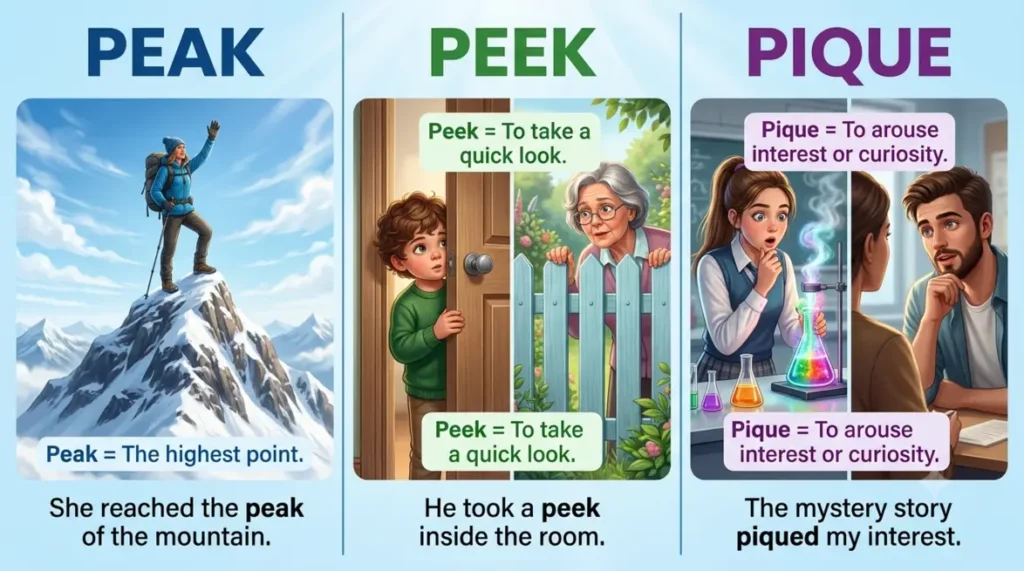
Many English learners and even native speakers confuse peak, peek, and pique because they sound the same. These words are called homophones. They share the same pronunciation but have different meanings and spellings.
People often search for “peak or peek or pique” because they want to avoid writing mistakes in emails, school work, business writing, and social media posts. A small spelling mistake can change the meaning of a sentence completely. For example, “peek interest” is incorrect, while “pique interest” is correct.
This guide explains the meaning of each word in simple language. You will learn the history behind these spellings, the difference between British and American English usage, and how to use each word correctly in daily life. By the end, you will confidently know when to use peak, peek, or pique without confusion.
Peak or Peek or Pique – Quick Answer
Here is the quick difference:
| Word | Meaning | Example |
| Peak | The top point or highest level | Sales reached their peak in July. |
| Peek | A quick look | She took a peek inside the box. |
| Pique | To create interest or irritation | The story piqued my interest. |
Easy Memory Tips
- Peak → Think of a mountain peak.
- Peek → Has “ee” like eyes looking.
- Pique → A fancy French-style spelling linked to interest.
- Read more:Affect or Effect: What’s the Difference ?
The Origin of Peak or Peek or Pique
The three words come from different language roots.
Peak
The word peak comes from old English words related to pointed mountain tops. Over time, it became linked to the highest point of anything, including success, performance, or numbers.
Example:
- The athlete reached her peak performance.
Peek
Peek appeared in English around the 17th century. It means to look secretly or quickly.
Example:
- He peeked through the window.
Pique
The word pique comes from French. It originally meant “to prick” or “to stimulate.” Today, it usually means creating curiosity or interest.
Example:
- The documentary piqued public interest.
The spelling differences exist because the words developed from different languages and meanings even though they sound alike today.
Read more:Burnt or Burned: Which Spelling Is Correct?
British English vs American English Spelling
The words peak, peek, and pique are spelled the same in both British and American English. However, usage style can vary slightly.
For example, British writers may use more formal expressions with “pique,” while American writing often prefers simpler language.
Comparison Table
| Word | British English | American English | Common Usage |
| Peak | Same spelling | Same spelling | Highest point |
| Peek | Same spelling | Same spelling | Quick look |
| Pique | Same spelling | Same spelling | Spark interest |
Example Sentences
| British Style | American Style |
| The news piqued public curiosity. | The news piqued public interest. |
| Tourism reached its peak in August. | Tourism hit its peak in August. |
Which Spelling Should You Use?
The correct spelling depends on your meaning.
Use “Peak” When Talking About:
- Highest points
- Maximum levels
- Mountains
- Best performance
Example:
- Electricity demand reached its peak.
Use “Peek” When Talking About:
- Quick looks
- Secret looks
- Short glances
Example:
- Can I take a peek at your notes?
Use “Pique” When Talking About:
- Interest
- Curiosity
- Irritation
Example:
- The headline piqued my curiosity.
Audience-Based Advice
| Audience | Best Choice |
| US readers | Use standard meanings carefully |
| UK readers | Formal writing may use “pique” more often |
| Global audience | Use simple examples for clarity |
Common Mistakes with Peak or Peek or Pique
Many writers mix these words because they sound alike.
Incorrect vs Correct Examples
| Incorrect | Correct |
| The article peaked my interest. | The article piqued my interest. |
| She took a peak inside. | She took a peek inside. |
| Sales reached a peek. | Sales reached a peak. |
Most Common Error
The biggest mistake is writing:
- “peaked my interest”
Correct version:
- “piqued my interest”
This is one of the most searched grammar mistakes online.
Peak or Peek or Pique in Everyday Examples
In Emails
- Your proposal piqued my interest.
- I took a quick peek at the report.
In News Headlines
- Oil prices reach peak levels.
- New evidence piques public curiosity.
On Social Media
- Sneak peek of our new product!
- This trailer really piqued my interest.
In Formal Writing
- Researchers observed peak activity during summer.
- The findings piqued scientific debate.
Peak or Peek or Pique – Google Trends & Usage Data
Search data shows that many people confuse these words, especially “pique” and “peak.”
Popular Search Trends
| Search Phrase | Why People Search It |
| Peak my interest | Common spelling mistake |
| Peek vs peak | Pronunciation confusion |
| Pique meaning | Less familiar word |
| Sneak peek | Popular media phrase |
Usage by Country
| Country | Common Usage Trend |
| United States | “Peak my interest” often searched incorrectly |
| United Kingdom | More formal use of “pique” |
| Canada | Balanced use of all three |
| Australia | Similar to British English usage |
The phrase “piqued my interest” is the grammatically correct version used in dictionaries and professional writing.
Comparison Table: Peak vs Peek vs Pique
| Feature | Peak | Peek | Pique |
| Part of Speech | Noun/Verb | Verb/Noun | Verb/Noun |
| Main Meaning | Highest point | Quick look | Stimulate interest |
| Common Phrase | Peak performance | Sneak peek | Pique curiosity |
| Easy Memory Tip | Mountain top | Looking eyes | Fancy French spelling |
FAQs
1. Is it “peak my interest” or “pique my interest”?
The correct phrase is “pique my interest.”
2. What does “peek” mean?
“Peek” means taking a quick or secret look.
3. What is the meaning of “peak”?
“Peak” means the highest point or maximum level.
4. Why do people confuse peak, peek, and pique?
They sound exactly alike but have different meanings and spellings.
5. Is “sneak peak” correct?
No. The correct phrase is “sneak peek.”
6. Can “pique” mean anger?
Yes. It can also mean irritation or resentment in formal English.
Example:
- He left in a fit of pique.
7. Which word is most common in daily conversation?
“Peak” and “peek” are more common in everyday speech, while “pique” appears more in formal writing.
Conclusion
Understanding the difference between peak, peek, and pique is important for clear writing. Even though these words sound the same, they have very different meanings.
Use peak when talking about the highest point, best performance, or maximum level. Use peek when describing a quick look or glance. Use pique when talking about curiosity, interest, or irritation.
The most common mistake is writing “peak my interest” instead of “pique my interest.” Learning the correct usage can improve your emails, essays, business writing, and social media posts.
A simple memory trick can help:
- Peak = top
- Peek = look
- Pique = interest
By choosing the correct spelling based on meaning, your writing will look more professional and easier to understand. Whether you write for American, British, or global readers, using these words correctly will help you avoid common grammar mistakes and communicate clearly.

I am Bahadar Ali, a professional content writer and the author behind GrammarDrive.com. I am passionate about making grammar simple and accessible for everyone. Through my writing, I aim to help learners and professionals communicate with clarity and confidence.