Many English learners and even native speakers ask the same question: Should I say “I have ate” or “I have eaten”? The confusion happens because both words come from the verb eat, but they are used in different grammar forms.
English verbs often change form depending on the tense. Some verbs follow simple patterns, while others are irregular. The verb eat is irregular, which makes it harder to remember the correct form. This is why people frequently search for “I have ate or I have eaten” online.
Understanding the difference is important for everyday conversations, emails, school assignments, and professional writing. Using the wrong form can make a sentence sound incorrect or awkward.
In this guide, you’ll learn the correct answer, the history of the words, common mistakes, examples, and practical advice on when to use each form. By the end, you’ll know exactly which phrase is correct and how to avoid this common grammar error.
I Have Ate or I Have Eaten – Quick Answer
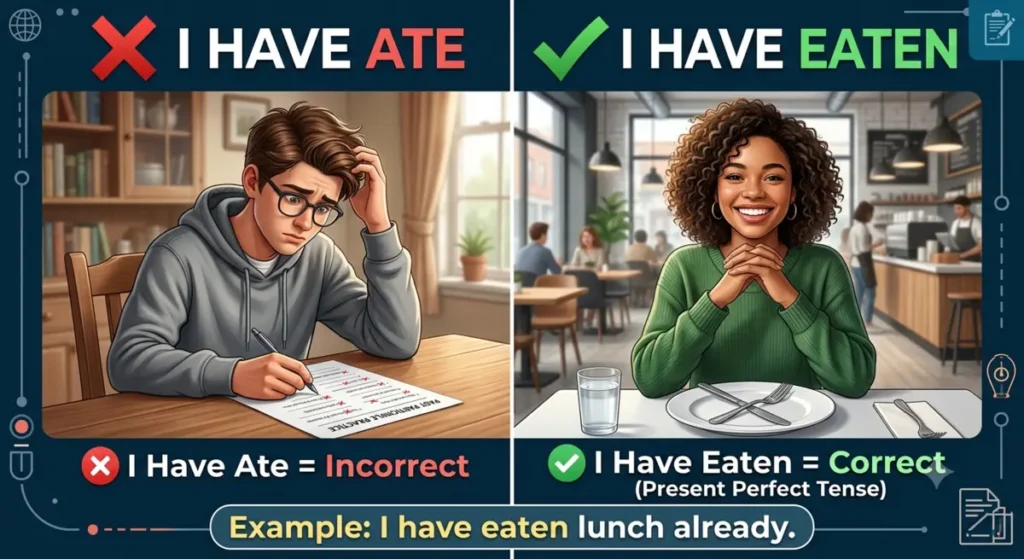
“I have eaten” is correct.
✅ Correct: I have eaten lunch already.
❌ Incorrect: I have ate lunch already.
The reason is simple:
- Ate = simple past tense
- Eaten = past participle
After have, has, or had, you must use the past participle form.
Read more:Gotten or Got: Which Word Should You Use?
Examples
| Correct | Incorrect |
| I have eaten breakfast. | I have ate breakfast. |
| She has eaten dinner. | She has ate dinner. |
| They had eaten before we arrived. | They had ate before we arrived. |
The Origin of I Have Ate or I Have Eaten
The verb eat comes from the Old English word etan, which meant “to consume food.”
Over time, English developed different verb forms:
| Form | Usage |
| Eat | Present tense |
| Ate | Past tense |
| Eaten | Past participle |
Because English inherited many irregular verbs from Germanic languages, the forms did not follow a simple pattern like “walk, walked, walked.”
Instead, the verb changed into:
- Eat
- Ate
- Eaten
This historical development explains why many learners mistakenly use ate where eaten is required.
Read more:Prey or Pray: What’s Difference and Which Word You Use?
British English vs American English Spelling
Unlike many spelling differences between British and American English, there is no spelling difference between ate and eaten.
Both British and American English use the same forms.
Examples
| British English | American English |
| I have eaten breakfast. | I have eaten breakfast. |
| She ate dinner early. | She ate dinner early. |
| We have eaten already. | We have eaten already. |
Comparison Table
| Feature | British English | American English |
| Eat | Eat | Eat |
| Ate | Ate | Ate |
| Eaten | Eaten | Eaten |
| Grammar Rule | Same | Same |
There is no regional spelling variation here.
Which Spelling Should You Use?
You should not choose between spellings because both forms serve different grammar purposes.
Use “Ate” When:
You are talking about a completed action in the past.
Examples:
- I ate lunch at noon.
- She ate pizza yesterday.
- We ate before the movie.
Use “Eaten” When:
The sentence contains:
- Have
- Has
- Had
Examples:
- I have eaten lunch.
- She has eaten dinner.
- They had eaten before leaving.
Audience-Based Advice
| Audience | Recommended Form |
| US Readers | Follow grammar rules |
| UK Readers | Follow grammar rules |
| Commonwealth Countries | Follow grammar rules |
| Global Audience | Follow grammar rules |
The correct choice depends on grammar, not location.
Common Mistakes with I Have Ate or I Have Eaten
Many people confuse past tense and past participle forms.
Mistake #1
❌ I have ate breakfast.
✅ I have eaten breakfast.
Mistake #2
❌ She has ate already.
✅ She has eaten already.
Mistake #3
❌ We had ate before arriving.
✅ We had eaten before arriving.
Mistake #4
❌ I eaten lunch yesterday.
✅ I ate lunch yesterday.
Easy Rule
If you see have, has, or had, use eaten.
I Have Ate or I Have Eaten in Everyday Examples
In Emails
✅ I have eaten before the meeting.
✅ I have eaten lunch and am available now.
In News Writing
✅ The athletes have eaten a balanced meal before the event.
On Social Media
✅ I have eaten too much cake today!
✅ We have eaten at that restaurant before.
In Formal Writing
✅ Researchers have eaten meals prepared under controlled conditions.
In Conversation
✅ I ate breakfast at 8 a.m.
✅ I have eaten already, thank you.
I Have Ate or I Have Eaten – Google Trends & Usage Data
Search interest in “I have ate or I have eaten” remains high because English learners frequently struggle with irregular verbs.
Common Search Queries
- Is I have ate correct?
- I have eaten meaning
- Ate vs eaten
- Have eaten grammar
- Past tense of eat
Countries Where the Question Is Popular
- United States
- United Kingdom
- Canada
- Australia
- India
- Pakistan
The topic is common in educational settings, grammar websites, and language-learning communities because irregular verbs are one of the most challenging parts of English grammar.
Comparison Table: Ate vs Eaten
| Feature | Ate | Eaten |
| Verb Type | Past tense | Past participle |
| Used Alone | Yes | Usually No |
| Used With Have/Has/Had | No | Yes |
| Example | I ate lunch. | I have eaten lunch. |
| Formal Writing | Yes | Yes |
| Everyday Speech | Yes | Yes |
FAQs
1. Is “I have ate” grammatically correct?
No. The correct phrase is “I have eaten.”
2. Why is “I have eaten” correct?
Because eaten is the past participle required after have.
3. When should I use “ate”?
Use ate for simple past tense actions.
Example: I ate dinner yesterday.
4. When should I use “eaten”?
Use eaten after have, has, or had.
Example: I have eaten dinner.
5. Is “have ate” ever correct?
No. Standard English grammar requires have eaten.
6. What is the past tense of eat?
The past tense is ate.
Example: She ate lunch.
7. What is the past participle of eat?
The past participle is eaten.
Example: She has eaten lunch.
Conclusion
The answer to “I have ate or I have eaten” is clear: “I have eaten” is correct. The confusion comes from the fact that the verb eat is irregular. Its forms are eat, ate, and eaten, and each serves a different purpose in English grammar.
Use ate when describing a completed action in the simple past tense. For example, “I ate breakfast this morning.” Use eaten when the sentence includes helping verbs such as have, has, or had. For example, “I have eaten breakfast already.”
Fortunately, there is no difference between British English and American English in this case. Both varieties follow the same grammar rules. The easiest way to remember the rule is simple: whenever you see have, has, or had, choose eaten, not ate.
Mastering this small grammar point can make your English sound more natural, accurate, and professional in conversations, emails, social media posts, and formal writing.

I am Bahadar Ali, a professional content writer and the author behind GrammarDrive.com. I am passionate about making grammar simple and accessible for everyone. Through my writing, I aim to help learners and professionals communicate with clarity and confidence.