Many English learners ask, “Should I say ‘I have saw’ or ‘I have seen’?” This is one of the most common grammar mistakes in English. The confusion happens because both saw and seen come from the verb see, but they are used in different grammar structures.
If you use the wrong form, your sentence may sound unnatural or incorrect to native speakers. This mistake often appears in emails, social media posts, school assignments, and workplace communication.
The good news is that the rule is simple. Once you understand when to use saw and when to use seen, you can avoid this error forever.
In this guide, you will learn the correct answer, the history of these verb forms, differences in usage, common mistakes, examples from everyday life, and practical advice for choosing the right form. Whether you are a student, writer, or English learner, this article will help you use these words with confidence.
I Have Saw or I Have Seen? – Quick Answer
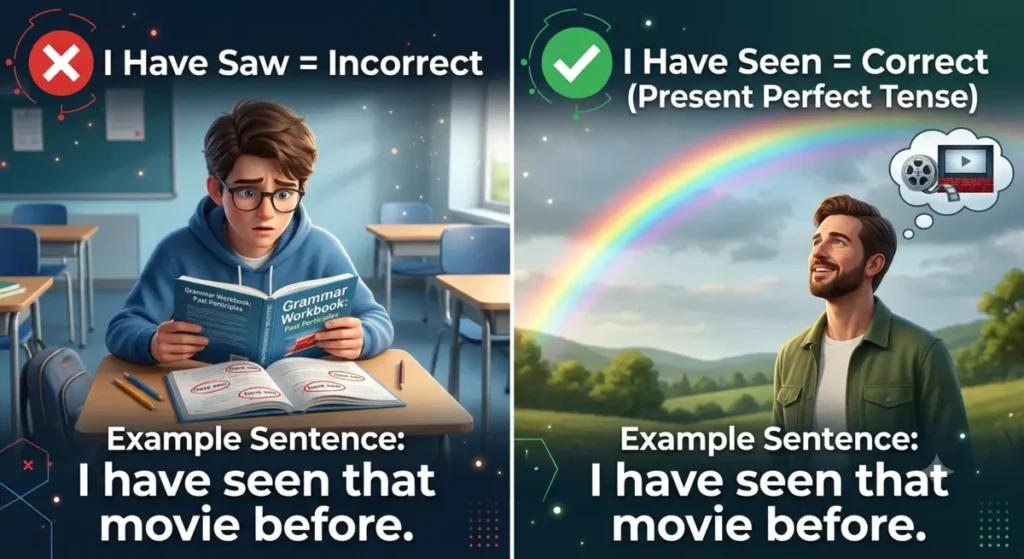
Correct: ✅ I have seen
Incorrect: ❌ I have saw
The phrase “have seen” is correct because seen is the past participle of the verb see.
Examples:
- ✅ I have seen that movie before.
- ✅ I have seen your email.
- ✅ We have seen many changes this year.
- ❌ I have saw that movie before.
- ❌ I have saw your message.
Simple Rule
- Saw = Simple past tense
- Seen = Past participle used with have, has, or had
Examples:
- I saw a bird yesterday.
- I have seen that bird before.
Read more:Morning or Mourning: What’s Difference and Which Word You Use?
The Origin of I Have Saw or I Have Seen?
The confusion comes from the irregular English verb see.
Verb forms:
| Verb Form | Word |
| Base Form | See |
| Past Tense | Saw |
| Past Participle | Seen |
English inherited these forms from older Germanic languages. Over time, the verb developed different forms for different tenses.
Because many regular verbs simply add -ed, learners often expect the same pattern for see. However, see is irregular, which means its forms must be memorized.
That is why:
- Yesterday I saw
- I have seen
Both words belong to the same verb family but serve different grammatical purposes.
Read more:Pain or Pane: What’s Difference and Which Word You Use?
British English vs American English Spelling
Unlike words such as color/colour or center/centre, there is no spelling difference between British and American English for saw and seen.
Both countries use the same verb forms.
Comparison Table
| Usage | British English | American English |
| Past Tense | I saw it yesterday. | I saw it yesterday. |
| Present Perfect | I have seen it before. | I have seen it before. |
| Formal Writing | I have seen the report. | I have seen the report. |
| Everyday Speech | I have seen that film. | I have seen that movie. |
The grammar remains identical.
Which Spelling Should You Use?
The answer is simple:
For American Audiences
Use:
- I saw
- I have seen
For British Audiences
Use:
- I saw
- I have seen
For Global Audiences
Use:
- I saw (simple past)
- I have seen (present perfect)
There is no regional spelling difference. The only choice depends on the sentence structure.
Common Mistakes with I Have Saw or I Have Seen
Many learners mix the past tense and past participle forms.
Mistake 1
❌ I have saw that video.
✅ I have seen that video.
Mistake 2
❌ She has saw the report.
✅ She has seen the report.
Mistake 3
❌ We had saw the problem earlier.
✅ We had seen the problem earlier.
Mistake 4
❌ Have you saw my message?
✅ Have you seen my message?
Mistake 5
❌ They have never saw snow.
✅ They have never seen snow.
Easy Memory Tip
If the sentence contains:
- Have
- Has
- Had
Use seen, not saw.
I Have Saw or I Have Seen? in Everyday Examples
Emails
✅ I have seen your request and will respond soon.
News Writing
✅ Officials have seen a rise in tourism this year.
Social Media
✅ I have seen this meme everywhere.
Workplace Communication
✅ We have seen strong results this quarter.
Academic Writing
✅ Researchers have seen similar patterns in previous studies.
Daily Conversation
✅ I have seen that restaurant before.
I Have Saw or I Have Seen? – Google Trends & Usage Data
Search interest for “I have saw or I have seen” is high among English learners worldwide. People often search this phrase because they hear both forms and want to know which is correct.
Countries Where This Question Is Common
- India
- Pakistan
- Philippines
- Bangladesh
- Nigeria
- Indonesia
Contexts Where It Appears Most
| Context | Common Usage |
| English Learning | Very High |
| School Assignments | High |
| Grammar Checks | High |
| Workplace Writing | Medium |
| Social Media | Medium |
Most grammar resources agree that “I have seen” is the correct form in present perfect sentences.
Comparison Table: Saw vs Seen
| Feature | Saw | Seen |
| Verb Type | Past Tense | Past Participle |
| Used Alone | Yes | No |
| Used with Have/Has/Had | No | Yes |
| Example | I saw a bird. | I have seen a bird. |
| Correct After “Have” | No | Yes |
| Formal Writing | Yes | Yes |
FAQs
1. Is “I have saw” grammatically correct?
No. I have saw is incorrect. The correct phrase is I have seen.
2. Why is “I have seen” correct?
Because seen is the past participle form of see, which must follow have, has, or had.
3. When should I use “saw”?
Use saw for the simple past tense.
Example:
- I saw him yesterday.
4. When should I use “seen”?
Use seen with helping verbs.
Examples:
- I have seen it.
- She has seen it.
- They had seen it.
5. Is “Have you saw?” correct?
No.
Correct:
- Have you seen my keys?
6. Do British and American English use different forms?
No. Both use saw and seen in exactly the same way.
7. How can I remember the rule?
Remember this formula:
- Have + Seen ✅
- Has + Seen ✅
- Had + Seen ✅
Never use saw after these helping verbs.
Conclusion
The answer to the question “I have saw or I have seen?” is clear: “I have seen” is always correct. The word saw is the simple past tense of see, while seen is the past participle. Whenever you use helping verbs such as have, has, or had, you must use seen.
This mistake is common because English contains many irregular verbs that do not follow standard patterns. However, learning the three forms of the verb makes the rule easy to remember: see, saw, seen. Once you know this sequence, choosing the correct form becomes simple.
Whether you are writing an email, posting on social media, preparing school work, or communicating professionally, using I have seen will make your English sound natural and correct. If you ever feel unsure, remember one quick rule: if the sentence contains have, has, or had, choose seen. Following this guideline will help you avoid one of the most common grammar errors in English and improve your confidence as a writer and speaker.

I am Bahadar Ali, a professional content writer and the author behind GrammarDrive.com. I am passionate about making grammar simple and accessible for everyone. Through my writing, I aim to help learners and professionals communicate with clarity and confidence.