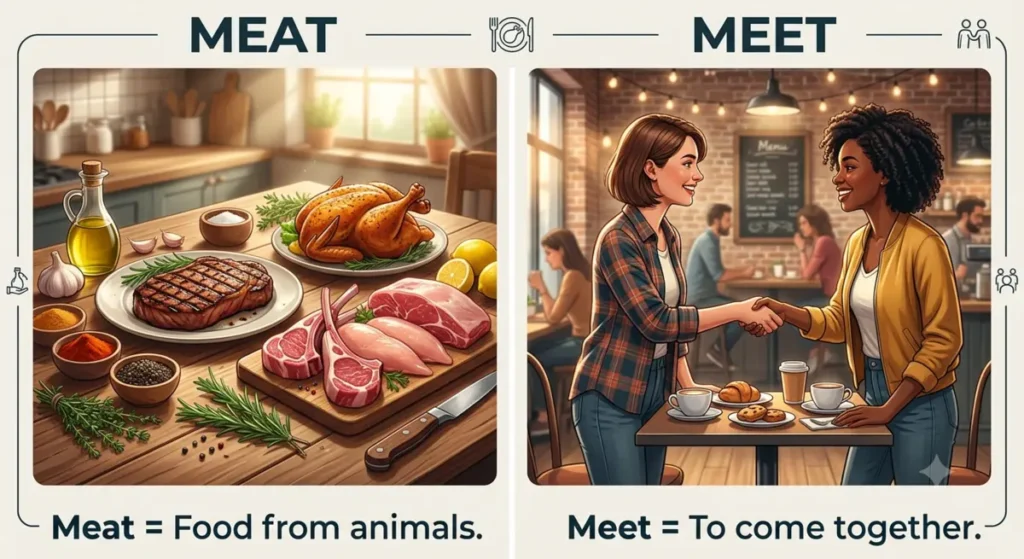
Many English learners confuse “meat” and “meet” because they sound the same. These words are called homophones. They have the same pronunciation but different meanings and spellings. This confusion is common in emails, school writing, social media posts, and even business communication.
People often search for “meat or meet” to learn the correct spelling and avoid mistakes. A small spelling error can completely change the meaning of a sentence. For example, “Let’s meat tomorrow” sounds strange because “meat” means animal food, while “meet” means to come together with someone.
Understanding the difference between these words improves writing and speaking skills. It also helps students, professionals, and English learners communicate clearly. In this guide, you will learn the meanings, origins, spelling differences, common mistakes, and everyday examples of “meat” and “meet.” By the end, you will know exactly when to use each word correctly.
Meat or Meet – Quick Answer
Meat is food from animals.
Meet means to see, greet, or come together with someone.
Examples:
- I ate grilled meat for dinner.
- We will meet at the café tomorrow.
Read more: Stole or Stolen: Which Word Should You Use?
Quick Comparison Table
| Word | Meaning | Example |
| Meat | Animal food | The soup contains beef meat. |
| Meet | To come together | I will meet my teacher today. |
The Origin of Meat or Meet
The words “meat” and “meet” come from Old English, but they developed different meanings over time.
Origin of Meat
The word meat comes from the Old English word mete, which once meant “food” in general. Over time, English speakers started using it mainly for animal flesh used as food.
Origin of Meet
The word meet comes from the Old English word mētan, meaning “to encounter” or “to come together.”
Read more: Laying or Lying: What’s the Difference ?
Why the Spelling Difference Exists
English spelling changed over hundreds of years because of pronunciation shifts, foreign language influence, and printing traditions. Even though “meat” and “meet” sound the same today, they kept different spellings because they have different origins and meanings.
British English vs American English Spelling
The words “meat” and “meet” are spelled the same in both British English and American English. There is no spelling difference between the two versions of English.
However, pronunciation and usage style may vary slightly depending on the region.
Examples
| Region | Example Sentence |
| American English | We will meet after lunch. |
| British English | They bought fresh meat from the market. |
Comparison Table
| Word | British English | American English |
| Meat | Meat | Meat |
| Meet | Meet | Meet |
Which Spelling Should You Use?
The correct spelling depends on the meaning you want.
Use “Meat” When:
- Talking about food from animals
- Discussing cooking or meals
- Referring to beef, chicken, lamb, or fish
Example:
- This restaurant serves spicy meat dishes.
Use “Meet” When:
- Talking about seeing someone
- Describing gatherings or introductions
- Discussing events or appointments
Example:
- I will meet the manager at 3 PM.
Audience-Based Advice
| Audience | Recommended Usage |
| US readers | Use “meat” for food and “meet” for gatherings |
| UK readers | Same spelling rules apply |
| Global audience | Follow standard English meanings |
Common Mistakes with Meat or Meet
Many people accidentally swap these words because they sound alike.
Incorrect:
- Let’s meat tomorrow.
Correct:
- Let’s meet tomorrow.
Incorrect:
- I don’t eat red meet.
Correct:
- I don’t eat red meat.
Common Error Patterns
| Incorrect Word | Correct Word | Reason |
| meat you later | meet you later | “Meet” means to see someone |
| grilled meet | grilled meat | “Meat” is food |
| nice to meat you | nice to meet you | Standard greeting phrase |
Meat or Meet in Everyday Examples
In Emails
- Let’s meet next Monday to discuss the project.
In News Writing
- Rising meat prices affect restaurants worldwide.
On Social Media
- Excited to meet my favorite singer today!
In Formal Writing
- The company will meet all safety standards.
In Casual Conversation
- We cooked fresh meat on the grill.
Meat or Meet – Google Trends & Usage Data
The word “meet” is searched more often globally because it appears in business, education, travel, and social communication.
The word “meat” is also popular, especially in cooking, health, and food-related searches.
Popular Contexts by Country
| Country | More Common Search | Common Context |
| United States | Meet | Business meetings |
| United Kingdom | Meat | Food and cooking |
| Australia | Meet | Social communication |
| Canada | Both | Everyday mixed usage |
Usage Comparison Table
| Keyword | Main Topic | Search Intent |
| Meat | Food | Cooking and nutrition |
| Meet | Communication | Social and business interaction |
FAQs About Meat or Meet
1. What is the difference between meat and meet?
“Meat” is animal food, while “meet” means to come together with someone.
2. Why do meat and meet sound the same?
They are homophones. Homophones sound alike but have different meanings and spellings.
3. Is “nice to meat you” correct?
No. The correct phrase is “nice to meet you.”
4. Which word is related to food?
“Meat” is related to food.
5. Which word is used for appointments?
“Meet” is used for appointments and gatherings.
6. Are meat and meet spelled differently in British English?
No. Both British and American English use the same spelling.
7. How can I remember the difference?
Think of “meat” as something you eat. “Meet” is about meeting people.
Conclusion
The difference between “meat” and “meet” is simple once you understand their meanings. “Meat” refers to animal food, while “meet” means to come together with someone. Even though the words sound identical, they serve completely different purposes in English.
Using the correct spelling is important in both casual and professional writing. A small mistake can confuse readers or change the meaning of a sentence. If you are talking about food, use “meat.” If you are talking about people gathering, appointments, or introductions, use “meet.”
These words are common in daily conversation, emails, business communication, social media, and news writing. Learning the difference helps improve grammar, writing clarity, and confidence in English communication.
The easiest way to remember the rule is this:
You eat meat, but you meet people.
By practicing these examples and tips, you can avoid common spelling mistakes and use both words correctly every time.

I am Bahadar Ali, a professional content writer and the author behind GrammarDrive.com. I am passionate about making grammar simple and accessible for everyone. Through my writing, I aim to help learners and professionals communicate with clarity and confidence.