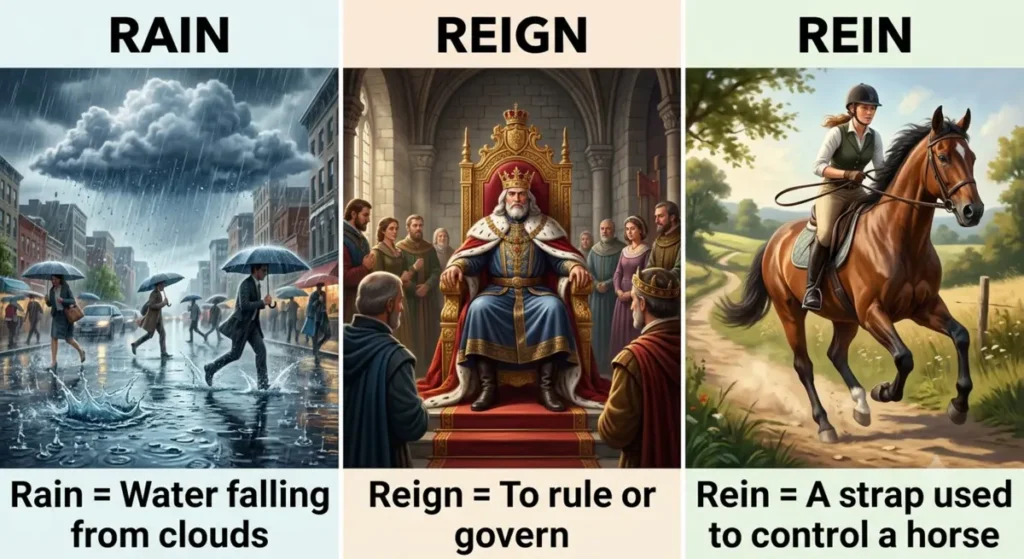
Many English learners and even native speakers confuse rain, reign, and rein because they sound exactly alike. These words are called homophones. They share the same pronunciation but have different meanings and spellings.
People often search for “rain or reign or rein” when writing emails, essays, social media posts, or professional documents. A small spelling mistake can completely change the meaning of a sentence. For example, “free rein” is correct, but many people wrongly write “free reign.” Likewise, “heavy rain” has nothing to do with kings or horses.
Understanding the difference between these three words helps improve grammar, writing clarity, and confidence in English communication. This guide explains the meanings, origins, spelling differences, and correct usage of each word in simple language. You will also see comparison tables, common mistakes, everyday examples, and answers to frequently asked questions.
By the end of this article, you will know exactly when to use rain, reign, or rein correctly.
Rain or Reign or Rein – Quick Answer
| Word | Meaning | Example |
| Rain | Water falling from clouds | It may rain today. |
| Reign | Rule or control by a king or leader | The queen’s reign lasted 40 years. |
| Rein | A strap used to control a horse; also means control | Parents should rein in spending. |
Simple Examples
- Rain → “Heavy rain flooded the streets.”
- Reign → “The king began his reign in 1990.”
- Rein → “She pulled the horse’s reins gently.”
Read more:Gotten or Got: Which Word Should You Use?
The Origin of Rain or Reign or Rein
Rain
The word rain comes from Old English regn. It has always been related to water falling from the sky. It is one of the oldest weather words in English.
Reign
Reign comes from the Latin word regnum, meaning “rule” or “kingdom.” It entered English through Old French. This word is connected with kings, queens, rulers, and power.
Rein
The word rein comes from Old French resne. It referred to straps used for controlling horses. Over time, it also gained a figurative meaning related to control or restraint.
Why the Spelling Differences Exist
English borrowed these words from different languages over hundreds of years. Even though they sound the same today, their spellings stayed different because their meanings and histories are different.
Read more:Prey or Pray: What’s Difference and Which Word You Use?
British English vs American English Spelling
The spellings rain, reign, and rein are the same in both British and American English. However, usage style and idioms can vary slightly.
Common Usage Differences
| Phrase | American English | British English |
| Rein in spending | Very common | Common |
| Free rein | Common | Common |
| Reign supreme | Common | Common |
| Heavy rain warning | Common | Common |
Key Point
There is no spelling change between US and UK English for these words. The confusion comes from pronunciation, not regional spelling differences.
Which Spelling Should You Use?
Use “Rain” When Talking About Weather
Choose rain when discussing water, storms, clouds, or weather conditions.
Example:
- “Rain is expected tomorrow.”
Use “Reign” When Talking About Rule or Power
Choose reign for kings, queens, leadership, dominance, or influence.
Example:
- “The emperor’s reign lasted decades.”
Use “Rein” When Talking About Control
Choose rein when discussing control, especially in phrases like “rein in” or “free rein.”
Example:
- “The manager tried to rein in costs.”
Audience-Based Advice
| Audience | Recommended Usage |
| US Readers | Follow standard meanings carefully |
| UK Readers | Same spelling and meanings |
| Global Audience | Use simple examples for clarity |
Common Mistakes with Rain or Reign or Rein
Mistake 1: “Free Reign”
❌ Incorrect: “The teacher gave students free reign.”
✅ Correct: “The teacher gave students free rein.”
Reason: The phrase comes from horse riding, meaning freedom to control movement.
Mistake 2: Using “Rain” for Power
❌ Incorrect: “The king’s rain lasted years.”
✅ Correct: “The king’s reign lasted years.”
Reason: Kings rule during a reign, not a rain.
Mistake 3: Confusing “Rein In” with “Rain In”
❌ Incorrect: “The company must rain in spending.”
✅ Correct: “The company must rein in spending.”
Reason: “Rein in” means control or limit something.
Rain or Reign or Rein in Everyday Examples
In Emails
- “Please rein in unnecessary expenses.”
- “Heavy rain may delay the meeting.”
In News Headlines
- “Floods Follow Days of Heavy Rain”
- “The Queen’s Reign Ends After 70 Years”
On Social Media
- “Let it rain!”
- “This singer continues to reign over pop music.”
In Formal Writing
- “The government tried to rein in inflation.”
- “The ruler’s reign changed the nation.”
Rain or Reign or Rein – Google Trends & Usage Data
Search interest for rain is highest in countries with strong seasonal weather discussions, including:
- United States
- United Kingdom
- Canada
- Australia
The word reign is commonly searched in historical, political, and entertainment contexts. People often use phrases like:
- “reign supreme”
- “long reign”
- “king’s reign”
The word rein is searched less often but appears frequently in business and idioms, such as:
- “rein in costs”
- “free rein”
Popularity Comparison
| Word | Main Context | Search Popularity |
| Rain | Weather | Very High |
| Reign | Royalty, power | Medium |
| Rein | Control, idioms | Lower |
Comparison Table: Rain vs Reign vs Rein
| Word | Part of Speech | Meaning | Common Phrase |
|—|—|—|
| Rain | Noun/Verb | Water from clouds | Heavy rain |
| Reign | Noun/Verb | Rule or dominance | Reign supreme |
| Rein | Noun/Verb | Control or restraint | Rein in |
FAQs About Rain or Reign or Rein
1. What is the difference between rain and reign?
Rain relates to weather. Reign relates to ruling or power.
2. What does “free rein” mean?
“Free rein” means freedom to act without restriction.
3. Is “free reign” wrong?
Yes. The correct phrase is free rein.
4. Why do rain, reign, and rein sound the same?
They are homophones. English borrowed them from different languages, but pronunciation became similar over time.
5. How do I remember the difference?
- Rain → weather
- Reign → ruler
- Rein → control
6. Can “rein” be used as a verb?
Yes. Example: “The company must rein in spending.”
7. Which word is most commonly used?
Rain is the most commonly used because weather is discussed daily worldwide.
Conclusion
The words rain, reign, and rein may sound the same, but they have very different meanings. Understanding these differences helps you avoid common grammar mistakes and write with confidence.
Use rain when talking about weather and water from the sky. Use reign for kings, queens, rulers, or dominance. Use rein when discussing control, limits, or horse riding. Remember that many mistakes happen because people rely on pronunciation instead of meaning.
A simple trick can help:
- Rain = weather
- Reign = ruler
- Rein = control
These words appear often in conversations, news, business writing, and social media. Choosing the correct spelling makes your communication clearer and more professional.
Whether you write for school, work, or online content, learning the correct use of rain, reign, and rein will improve your English skills and help your writing look polished and accurate.

I am Arshman Ali a professional English writer and English professor with a passion for language and a commitment to excellence. I bring precision and clarity to my writing, and the same high standards into my classroom. For me, language is not just a profession it is a purpose.