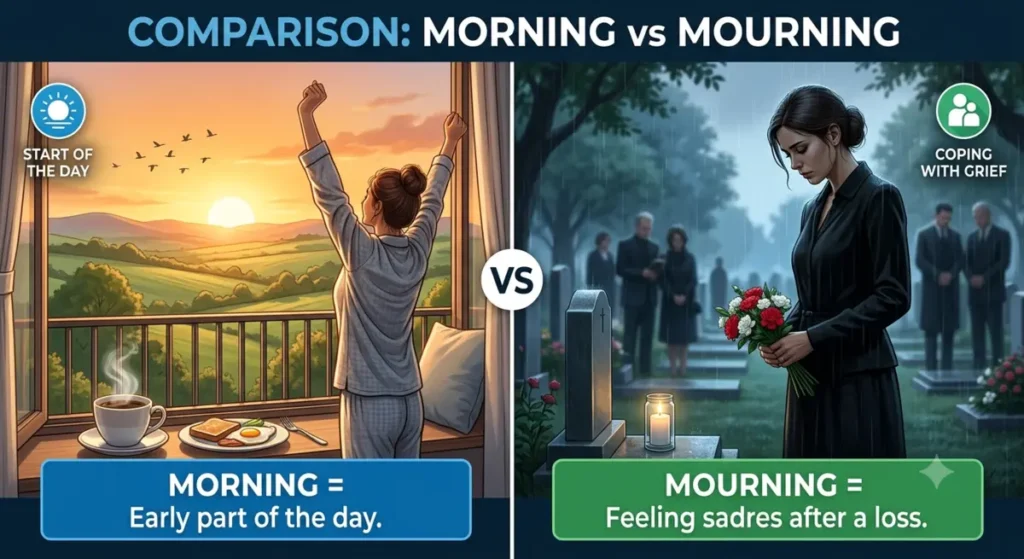
Many people search for “morning or mourning” because the two words sound the same but have very different meanings. This makes them easy to confuse in writing, emails, school work, and social media posts.
The word “morning” relates to the early part of the day. The word “mourning” means feeling sadness after someone dies. Since both words are pronounced the same way, writers often mix them up. This is a common English mistake, especially for learners and non-native speakers.
Understanding the difference between “morning” and “mourning” helps improve grammar, spelling, and professional writing. It also prevents embarrassing mistakes in formal messages or emotional situations.
In this guide, you will learn the quick difference between these words, their origins, spelling patterns, real-life examples, and which word to use in different situations. By the end, you will never confuse “morning” and “mourning” again.
Morning or Mourning – Quick Answer
“Morning” means the early part of the day.
Example:
- Good morning!
- I drink coffee every morning.
“Mourning” means feeling grief or sadness after a death.
Example:
- The family is mourning their loss.
- She wore black during the mourning period.
Read more: Can or May: What’s the Difference ?
Quick Comparison Table
| Word | Meaning | Example |
| Morning | Early part of the day | I wake up early every morning. |
| Mourning | Grief after death | They are mourning their grandfather. |
The Origin of Morning or Mourning
The word “morning” comes from Old English “morgen,” which meant the start of the day or sunrise. It has been used for hundreds of years to describe the hours before noon.
The word “mourning” comes from the Old English word “murnung,” which means sorrow, grief, or sadness. It is linked to emotional pain after losing someone.
Even though the words sound the same, they developed from different roots and meanings. English has many homophones like this. Homophones are words that sound alike but have different spellings and meanings.
That is why “morning” and “mourning” are often confused in writing.
Read more: Beside or Besides: What’s the Difference ?
British English vs American English Spelling
There is no spelling difference between British English and American English for “morning” and “mourning.” Both versions of English use the same spellings.
However, the words may appear in different writing styles or cultural contexts.
Examples
| Context | British English | American English |
| Greeting | Good morning | Good morning |
| Sadness after death | National mourning | National mourning |
| News writing | Mourning period announced | Mourning period announced |
Unlike words such as “colour” and “color,” these words stay the same in both spelling systems.
Which Spelling Should You Use?
You should use “morning” when talking about time, sunrise, or daily routines.
Use “mourning” when talking about grief, funerals, or sadness after death.
For US Audiences
- Use “morning” for time-related writing.
- Use “mourning” for grief-related writing.
For UK and Commonwealth Audiences
The same spelling rules apply.
For Global English
These spellings are accepted everywhere in English-speaking countries.
The key is understanding the meaning, not the region.
Common Mistakes with Morning or Mourning
Many writers use these words incorrectly because they sound identical.
Common Errors
| Incorrect Sentence | Correct Sentence |
| I go jogging every mourning. | I go jogging every morning. |
| The country observed morning after the tragedy. | The country observed mourning after the tragedy. |
| Good mourning everyone. | Good morning everyone. |
| She is morning her friend. | She is mourning her friend. |
Easy Memory Trick
- “Morning” has “sun” meaning in your mind.
- “Mourning” contains “mour,” linked to sadness and sorrow.
Morning or Mourning in Everyday Examples
In Emails
- Good morning, Sarah.
- The company is mourning the loss of its founder.
In News Headlines
- Morning traffic caused delays downtown.
- The nation is mourning the actor’s death.
On Social Media
- Beautiful morning at the beach!
- Fans are mourning the singer today.
In Formal Writing
- Morning meetings start at 9 AM.
- A mourning ceremony was held yesterday.
Morning or Mourning – Google Trends & Usage Data
“Morning” is searched much more often than “mourning” because people use it daily in greetings, schedules, and routines.
“Mourning” becomes more popular during news events, public deaths, and memorial discussions.
Usage by Context
| Word | Most Common Use |
| Morning | Greetings, time, routines |
| Mourning | Death, grief, funerals |
Popularity by Country
| Country | More Common Search |
| United States | Morning |
| United Kingdom | Morning |
| Canada | Morning |
| Australia | Morning |
| India | Morning |
Since “morning” is part of everyday conversation, it appears far more often in online searches and written English.
Morning vs Mourning Comparison Table
| Feature | Morning | Mourning |
| Meaning | Early part of the day | Grief after death |
| Part of Speech | Noun | Noun/Verb |
| Common Context | Greetings and schedules | Funerals and sadness |
| Example | Good morning | Mourning the loss |
| Emotional Tone | Neutral or positive | Sad or emotional |
FAQs About Morning or Mourning
1. What is the difference between morning and mourning?
“Morning” means the early part of the day. “Mourning” means sadness after a death.
2. Why do morning and mourning sound the same?
They are homophones. Homophones are words with different meanings but the same pronunciation.
3. Is “good mourning” correct?
No. The correct greeting is “good morning.”
4. Can mourning be used as a verb?
Yes. Example: “They are mourning their loved one.”
5. Which word relates to funerals?
“Mourning” relates to grief, funerals, and memorials.
6. Is there a spelling difference in British English?
No. Both British and American English use the same spellings.
7. How can I remember the difference?
Think of “morning” as sunrise and “mourning” as sadness.
Conclusion
The difference between “morning” and “mourning” is simple once you understand the meanings. “Morning” refers to the early hours of the day, while “mourning” describes grief after losing someone. Even though the words sound exactly alike, their meanings are completely different.
This confusion happens because English contains many homophones. Writers often make mistakes when typing quickly or relying only on pronunciation. Using the correct word is important in emails, school assignments, news writing, and professional communication.
A simple memory trick can help. Connect “morning” with sunrise and daily routines. Connect “mourning” with sadness and funerals. This makes it easier to choose the correct spelling every time.
Whether you write for American, British, or global audiences, the spelling rules remain the same. The best choice depends entirely on the meaning you want to express. Once you know the context, picking the right word becomes easy and natural.

I am Arshman Ali a professional English writer and English professor with a passion for language and a commitment to excellence. I bring precision and clarity to my writing, and the same high standards into my classroom. For me, language is not just a profession it is a purpose.